AI
The Employer Who Uses AI Right Is Hiring More Entry-Level Workers
Jobspeaker
September 20th, 2026

Strada Institute data shows AI-forward employers are expanding entry-level hiring. Here's what that means for the education-to-work pipeline—and what educators can do now.
The Employer Who Uses AI Right Is Hiring More Entry-Level Workers
Strada Institute data shows AI-forward employers are expanding entry-level hiring. Here's what that means for the education-to-work pipeline—and what educators can do now.
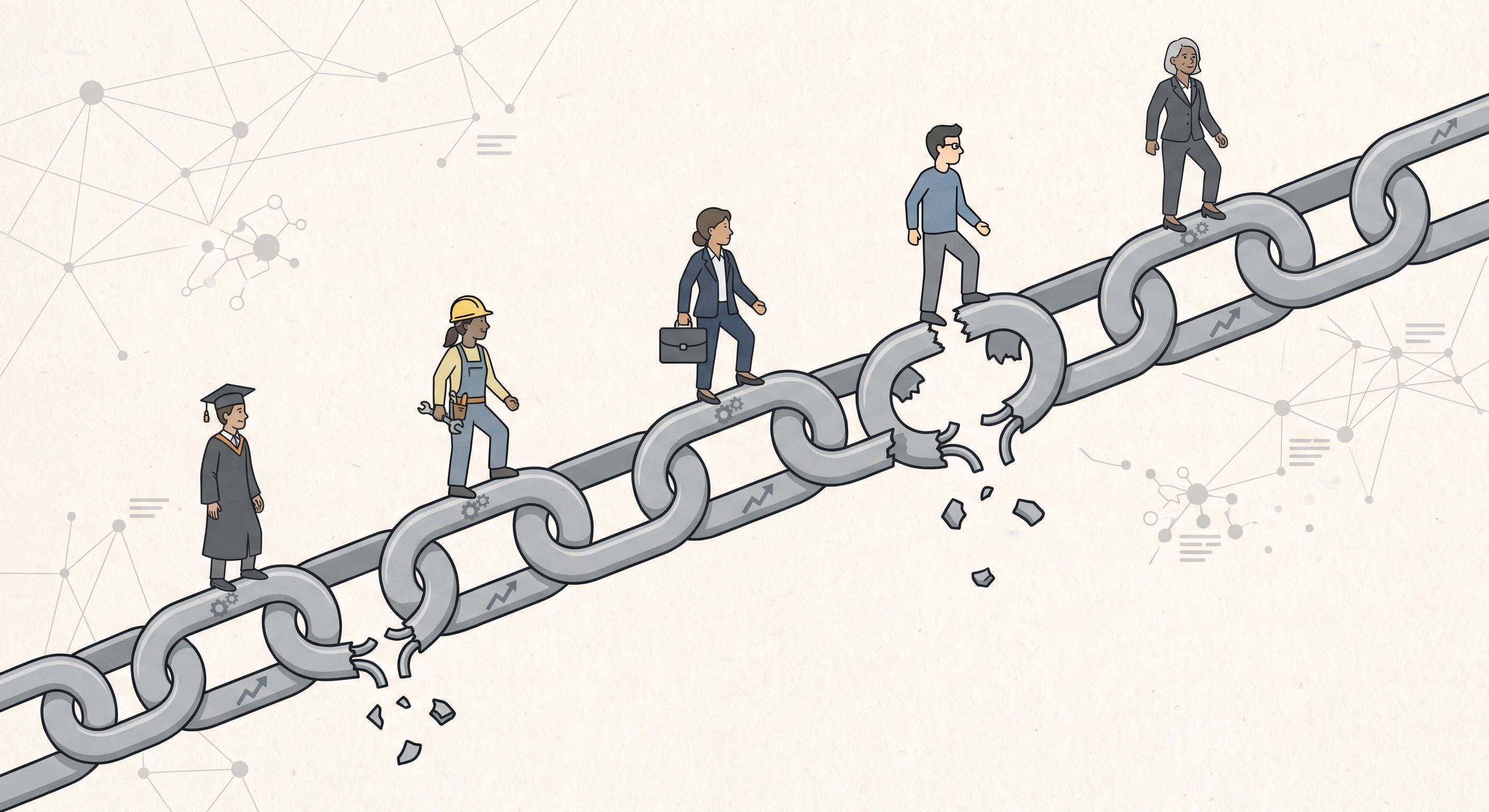
There is a version of the AI-and-jobs story that has become almost reflexive: automation arrives, entry-level roles disappear, and the workers who would have filled them are left without a foothold. It is a coherent story. It is also, according to the most nuanced data available right now, importantly incomplete. A closer reading of two reports published this fall — the Strada Institute's Entry-Level Hiring in the AI Era and a September 2026 IntuitionLabs analysis of payroll and job-posting data — reveals something more interesting and, for educators and workforce partners, considerably more actionable: the outcome for entry-level workers isn't determined by whether a company uses AI. It's determined by how they use it.
That distinction matters enormously for anyone who touches the education-to-employment pipeline — advisors, faculty, career services staff, community college administrators, workforce development directors. Because if the mechanism driving outcomes is the strategic intent behind AI deployment, then the preparation graduates receive before they walk into a hiring process is not just important — it is the variable that tips the scale.
Two Companies, Two Futures for the Same Graduate
The Strada Institute survey, based on responses from 1,498 executives and senior talent leaders at U.S. organizations that hire entry-level employees, found that nearly three times as many senior talent leaders expect AI to increase rather than decrease entry-level hiring in 2026. More concretely, 46% of employers that have at least explored AI reported an overall increase in entry-level hiring in 2025. Those are not the numbers most people expect to hear.
But the headline figure obscures a fork in the road. Strada's data shows that firms reducing entry-level hiring due to AI tend to be deploying it primarily to automate routine tasks — the kind of work that used to serve as the on-ramp for new graduates. The companies expanding entry-level hiring are doing something structurally different: they are using AI to elevate those roles, pushing junior workers into more complex, judgment-intensive responsibilities faster than was previously possible, and backfilling the resulting demand with new hires.
Think about what that means in practice. Two employers in the same industry, both using the same AI tools. One automates the entry-level layer and hires fewer people. The other uses AI to make its entry-level employees more capable, takes on more ambitious work as a result, and hires more. A graduate lands at one or the other — and the difference between those two experiences is not visible from a job posting. It may not even be visible in an interview. What determines which graduate lands where, and how well they perform, is whether they arrive understanding AI as a tool for doing harder things rather than a replacement for doing easier ones.
Where the Payroll Data Gets Complicated
The IntuitionLabs analysis adds an essential layer of realism to the Strada findings. The honest summary of the data landscape, IntuitionLabs concludes, is that we are looking at a genuine puzzle, not a settled verdict. Payroll and job-posting data — including sources from Stanford and Indeed — tend to show contraction concentrated in junior, AI-exposed roles. Forward-looking executive-intention surveys like Strada's capture stated plans that skew more optimistic. Neither data type is wrong; they measure different things at different points in a hiring cycle that is still unfolding.
What the job-posting data does show clearly: prompt engineer is already fading as a job title, entry-level hiring has gotten measurably harder in AI-adjacent roles, and — critically — half of all AI-related job postings now sit outside of IT departments. That last point is perhaps the most important signal for curriculum designers and career counselors. AI is no longer a technical specialty. It is a cross-functional expectation. The accounting graduate, the communications major, the healthcare administration student — they are all entering a labor market where AI competency is assumed, not optional.
The tension between Strada's optimistic survey data and the more cautious payroll picture is not a reason for paralysis. It is a reason for precision. The jobs that are contracting are the ones where AI replaces routine, bounded tasks. The jobs that are expanding are the ones where AI amplifies judgment, communication, and problem-solving. Educators and advisors who help students understand that distinction — concretely, not abstractly — are giving them something that a credential alone cannot.
The Second-Order Effects No One Is Talking About Enough
If the companies expanding entry-level hiring are the ones using AI to elevate roles, there is a second-order consequence that deserves more attention: the ramp-up expectations for new hires are changing. A graduate entering an AI-forward employer in 2026 may be expected to handle analytical, synthetic, or client-facing work within weeks rather than months, because AI is handling the scaffolding tasks that used to occupy early tenure. The on-ramp is shorter. The ceiling is higher. And the gap between graduates who can operate at that pace and those who cannot is wider than it has ever been.
This is where the CompTIA Workforce and Learning Trends 2026 report becomes relevant context. Only 34% of companies have a formal, organization-wide reskilling or upskilling program. Most of the movement toward skills-based hiring has been concentrated in the hiring process itself — dropping degree requirements — but CompTIA's data shows that removing credential requirements has not meaningfully changed the mix of talent that actually gets hired. Employers say they want skills. They are not yet consistently building the infrastructure to develop those skills internally. That gap does not resolve itself. It places more weight on the preparation learners receive before they arrive.
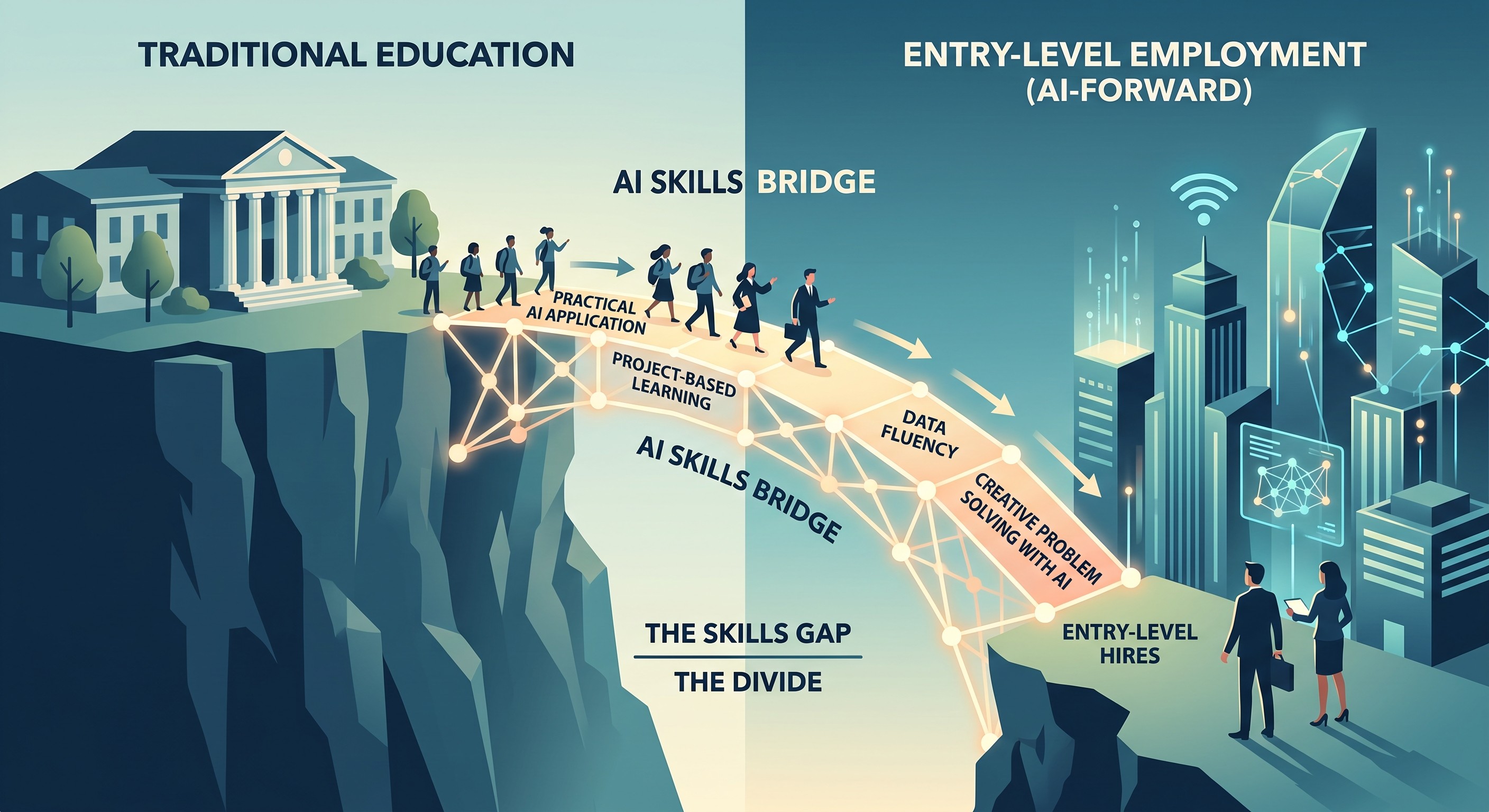
For institutions, that is not a criticism — it is an opportunity. Community colleges, universities, and workforce training programs that can credibly signal the difference between AI exposure and AI fluency will become dramatically more valuable to employers navigating exactly this problem. The question is how to make that signal legible, consistent, and trusted.
What Educators and Employers Can Do — Together — Right Now
The Strada and IntuitionLabs data, taken together, suggest a clear set of priorities for the education-to-work ecosystem. None of them require waiting for standards bodies to finalize frameworks or for the macroeconomic picture to clarify. They can begin with what institutions and employers already have.
First, career advising needs to incorporate employer AI strategy, not just job titles. The question students should be asking — and advisors should be helping them ask — is not "does this company use AI?" but "how does this company use AI, and what does that mean for the work I'll actually do?" That is a new skill for career services teams, and it requires building new relationships with employer partners to get honest answers.
Second, curriculum integration needs to move from AI-as-topic to AI-as-method. The MITR Media analysis published this fall found that over 60% of U.S. higher education institutions will have integrated AI into their curricula by 2026 — a 35% jump since 2024 — but that adoption has outpaced depth and consistency. Speed matters, and institutions moved fast; now the work is ensuring that what students encounter is rigorous enough to transfer into those elevated entry-level roles, not just familiar enough to check a box.
Third, employer partnerships need to focus on role design, not just hiring pipelines. The companies that are expanding entry-level hiring are making deliberate choices about what those roles look like. Educators who engage employers at that level — understanding how roles are being redesigned, what judgment calls AI cannot make, where human skills are becoming more rather than less important — can build curricula and credentials that align with where demand is actually growing.
The data is genuinely mixed, and anyone who tells you otherwise is simplifying. But the mechanism is clear: graduates who understand AI as a tool for doing harder, more complex, more valuable work are entering a hiring market where a meaningful and growing share of employers are actively looking for them. Building the pipeline that produces those graduates is not a challenge any single institution, employer, or platform solves alone. It is exactly the kind of problem that gets solved when everyone in the ecosystem — faculty, advisors, workforce partners, and employers — decides to work on it together. The opening is there. The employers who are hiring more entry-level workers because of AI are showing us what the destination looks like. The work now is building the road.