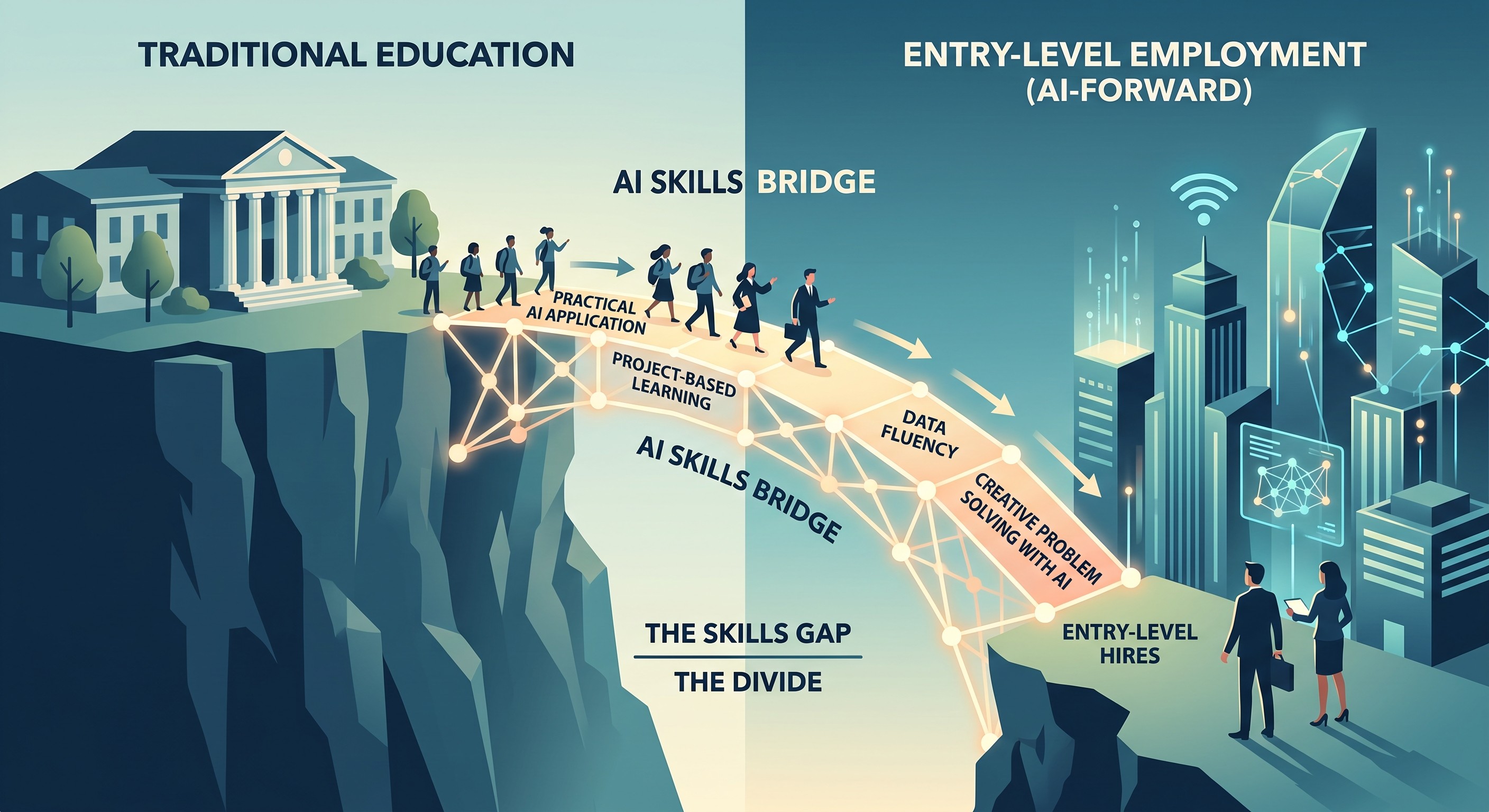
60% of U.S. colleges added AI to curricula, but depth lags employer needs. Here's what that gap costs early-career workers—and how to close it.
The Depth Problem: AI in Curriculum vs. AI Readiness
60% of U.S. colleges added AI to curricula, but depth lags employer needs. Here's what that gap costs early-career workers—and how to close it.
There is a number that should stop every educator and workforce developer in their tracks: over 60% of U.S. higher education institutions will have integrated AI into their curricula by 2026, a 35% jump in just two years. On its face, that sounds like a success story — higher education moving with unusual speed to meet a generational shift in the labor market.
But speed and depth are not the same thing. And right now, the gap between them is quietly becoming one of the most consequential problems in the education-to-employment pipeline.
The same analysis that produced that adoption figure — from MITR Media's review of AI in higher education — includes a harder finding: institutions moved quickly to add AI somewhere in the curriculum, but far fewer moved as quickly to ensure that addition was rigorous, consistent, or genuinely job-ready. Meanwhile, 72% of employers now prioritize AI competencies in job applications — across STEM and non-STEM fields alike. The gap between those two realities is where early-career workers are getting caught.
Exposure Is Not Competency
To understand why this matters so much, it helps to think about what "AI in the curriculum" can actually mean in practice. At one end of the spectrum, it means a module in an existing course — a week on prompt engineering, a guest lecture on machine learning, a revised syllabus that acknowledges ChatGPT exists. At the other end, it means something like what the University of Leicester launched in September 2026: full Microsoft 365 Copilot access deployed to all 25,000 students and staff simultaneously, making AI-assisted work a baseline experience for every member of the campus community from the first day of the academic year. Not an elective. Not a pilot. Infrastructure.
The distance between those two approaches is enormous — and employers are beginning to feel it. When 72% of hiring managers say AI competency is a priority, they are not asking whether a candidate has heard of large language models. They are asking whether the candidate can use AI tools to do real work faster, more accurately, and with better judgment about when to trust the output and when to push back on it. That kind of fluency does not come from a module. It comes from months of embedded, repeated practice — the kind that the Leicester model is designed to produce and that a checkbox curriculum addition simply cannot.
The risk of the current moment is that institutions — under genuine pressure to respond quickly, with limited budgets and real faculty constraints — check the box and move on. Students graduate believing they are AI-ready because they took a course that mentioned AI. Employers hire them and discover they are not. The credential signals one thing; the capability delivers another. That is not a student failure or a faculty failure. It is a systems failure, and it is one that educators, institutions, and workforce partners are in a uniquely strong position to correct — together.
What Employers Are Actually Measuring — and Why the Bar Is Moving
The employer side of this equation is more nuanced than the "AI will take your job" narrative suggests, and understanding it is essential for anyone advising learners right now.
The Strada Institute for the Future of Work's Entry-Level Hiring in the AI Era report, based on a survey of nearly 1,500 executives and senior talent leaders, contains a finding that reframes the entire conversation: nearly three times as many senior talent leaders expect AI to increase rather than decrease entry-level hiring in 2026, and 46% of employers that have explored AI reported an overall increase in entry-level hiring in 2025. That is not the story most people expect to hear.
But the mechanism behind that finding is everything. Firms that are expanding entry-level hiring tend to be using AI to elevate those roles into more complex, higher-judgment work. Firms that are cutting entry-level hiring tend to be using AI primarily to automate routine tasks — and finding that the routine tasks were most of what entry-level employees were doing. The difference is not about the technology. It is about how employers have chosen to deploy it, and — critically — whether the candidates they hire are capable of stepping into elevated, AI-augmented responsibilities on day one.
This is the second-order effect that most curriculum conversations miss. Adding AI to a course prepares students for a world where AI is a topic. Deeply integrating AI into the entire learning experience prepares students for a world where AI is a tool — one they are expected to wield with confidence, critical judgment, and domain expertise from their first week on the job. Employers using AI to expand roles are looking for the second kind of graduate. Right now, they are not always finding them.
The Credentialing Gap Inside the Depth Problem
There is a third layer here that compounds the first two, and it lives in credentialing. Even when institutions are doing the deeper work — when AI fluency is genuinely embedded across the curriculum, not just mentioned in one course — there is often no reliable signal to communicate that fact to employers. A transcript does not distinguish between a university that deployed Copilot campus-wide and one that added a two-week AI unit to an introductory tech course. Both graduates may list "AI coursework" on a resume. Neither credential tells the employer what they actually need to know.
This is not a hypothetical concern. IntuitionLabs' September 2026 analysis of AI hiring data found that entry-level roles are narrowing and shifting in composition — with job-posting data from sources like Stanford and Indeed showing contraction concentrated specifically in junior, AI-exposed roles. At the same time, the title "prompt engineer" is already fading, and half of all AI-related job postings now sit outside IT departments. AI competency has become a cross-functional expectation, not a specialized credential.
When employers cannot reliably distinguish depth of AI preparation from breadth of AI exposure, several things happen. Hiring becomes more informal and network-dependent — favoring candidates with connections over candidates with skills. Institutions that are doing the harder work of deep integration do not get credit for it in the labor market. And learners at those institutions are disadvantaged in job searches despite being better prepared. Credential frameworks that can signal real competency — not just exposure — are not a nice-to-have. They are the missing infrastructure that makes the depth investment legible to employers.
What Educators and Employers Can Do Right Now
The University of Leicester's institution-wide Copilot deployment is an instructive model, but it is also a high-resource move that not every institution can replicate immediately. What matters more than any single technology decision is the underlying commitment: that AI fluency is treated as foundational infrastructure, woven through every field of study, not siloed in a computer science elective.
That means educators and curriculum designers asking a harder version of the question they are already asking. Not "do we have AI in the curriculum?" but "do our graduates leave here able to use AI tools to do real work in their field, with judgment about when and how?" Those are very different questions, and the gap between them is exactly where the education-to-employment mismatch lives.
On the employer side, the Strada data offers a clear directive: organizations that use AI to elevate entry-level roles rather than simply automate them are the ones seeing hiring expand. That is a choice about implementation, and it is one employers can make deliberately — in partnership with the institutions supplying their talent pipeline. Employers who communicate clearly to education partners about what elevated, AI-augmented entry-level work actually looks like give institutions something concrete to design toward.
And at the system level — across institutions, employers, accreditors, and workforce platforms — the shared work is building credentialing frameworks that make depth visible. When a graduate can demonstrate not just that they encountered AI in school, but that they used it fluently and critically across real coursework for two or three years, that signal needs to be legible on a resume, a portfolio, or a verified credential.
The 60% adoption figure is genuinely encouraging. It reflects real effort by educators working under real constraints, responding to a labor market signal as fast as any sector moves. The goal now is to deepen that work — to move from AI as a topic on a syllabus to AI as a lived, practiced, assessed dimension of what it means to earn a degree. Institutions, employers, and workforce partners working toward that together are not just closing a curriculum gap. They are building the pipeline that the next generation of AI-augmented work is going to depend on.