Future of Work
AI Is Reshaping Entry-Level Work Faster Than Education Can Keep Up
Jobspeaker
September 23rd, 2026
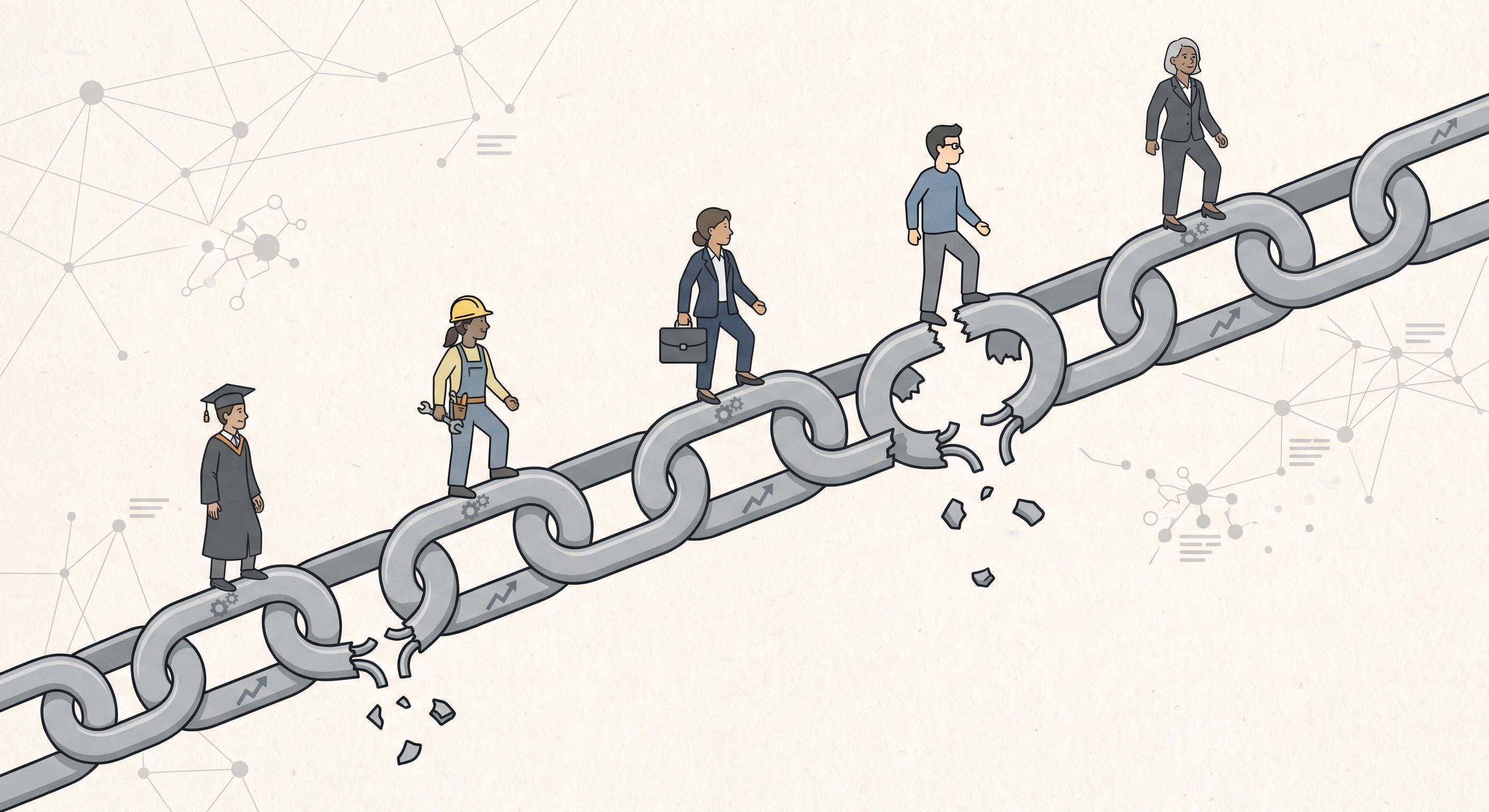
Employers are 2.7x more likely to expect AI to grow entry-level hiring—but the bar on day one is rising fast. Here's what the latest data means for students and institutions.
AI Is Reshaping Entry-Level Work Faster Than Education Can Keep Up
Employers are 2.7x more likely to expect AI to grow entry-level hiring—but the bar on day one is rising fast. Here's what the latest data means for students and institutions.
🔭 The Big Picture This Week
New data published this week puts a sharper edge on the entry-level hiring debate: a Journalist's Resource analysis synthesizing the Strada Institute and Handshake research found that employers are 2.7 times more likely to expect AI to grow entry-level hiring than shrink it — but in the same breath, those employers are raising the bar on day one, shifting junior roles away from routine tasks and toward analytical judgment. Layered on top of that, the latest weekly jobless claims dropped to 196,000 — the 2026 average is now tracking at a 57-year low — meaning the macro labor market stays superficially calm even as the composition of who gets hired and into what kinds of roles keeps shifting underneath. The week's other big signal: the U.S. Department of Labor is formally embedding AI skills into Registered Apprenticeships nationwide, a move that could reshape the earn-while-you-learn pathway just as traditional entry-level white-collar routes narrow.
💬 Our Take
The surface numbers look stable — claims low, openings holding — but the real action is in the mix. Entry-level roles aren't disappearing; they're being redefined, and the students who arrive on day one able to think analytically and communicate clearly will have a decisive advantage over those who can't. That's exactly the education-to-work bridge Jobspeaker is built to strengthen, working alongside colleges, training providers, and employers to make sure learners know what's actually being asked of them.
📊 Macro & Economic Context
Claims Fall to 196,000 — the 2026 Average Is Now a 57-Year Low | DOL / YourNews
New unemployment filings fell below 200,000 last week, pushing the 2026 year-to-date average to a level not recorded in 57 years. Before 2026, initial claims had fallen to 196,000 or lower only four times since 1969, and no week between 1970 and 2018 recorded a claims total that low. Continuing claims, which measure people receiving benefits after an initial filing, also declined, falling to 1.73 million — their lowest level since 2024.
Why it matters: A historically quiet layoff environment means employers aren't shedding workers at scale — but for jobseekers and recent grads, the harder truth is that low firing is masking low hiring, and the roles being filled increasingly demand skills that many new entrants don't yet have.
Read the full story →
JOLTS: Job Openings Hold at 7.3 Million in July — But the Hires Rate Is Softening | BLS / EPI
The number of job openings was little changed at 7.3 million in July, the Bureau of Labor Statistics reported; hires and total separations both changed little at 5.1 million, and within separations, quits and layoffs also remained steady. The hires rate softened to 3.2% in July — one of the weakest measures in the labor market today. Little changed in the overall JOLTS picture for July, but revisions point to a weaker June than originally reported, and between June and July hires dropped a bit more — a worsening sign for labor market entrants.
Why it matters: Seven million openings sounds like opportunity, but a softening hires rate means employers are posting without pulling the trigger — a pattern that disproportionately hurts new graduates and career changers who depend on fresh hiring cycles to get their foot in the door.
Read the full story →
🎓 Higher Education
AI Is No Longer Just for Engineering Students — Universities Are Embedding It Across Every Major | Digital Education Council / CollegeSimplified
Where AI literacy coursework was once an optional elective for technical majors only, leading institutions in 2026 are making it a mandatory foundational credit for all degree paths, and cross-disciplinary AI labs — once limited to engineering buildings — are now accessible across arts, humanities, and business. The goal of these curriculum changes is to foster comprehensive digital literacy, with courses focused on practical tool application, prompt engineering, and ethical frameworks — making the technology accessible without requiring an advanced programming background. A companion global survey from the Digital Education Council finds that faculty intent to use AI in the U.S. and Canada has actually declined by 9 percentage points, from 76% in 2025 to 67% in 2026 — the lowest adoption intent of any region surveyed.
Why it matters: Curriculum change without faculty buy-in is an implementation risk — institutions moving fast on AI requirements will need to invest as heavily in faculty development as in course redesign if students are to graduate genuinely work-ready.
Read the full story →
DOL Launches National Initiative to Embed AI Skills in Registered Apprenticeships | U.S. Department of Labor
The U.S. Department of Labor announced a national contracting opportunity designed to accelerate the integration of artificial intelligence skills into Registered Apprenticeship programs, with the Employment and Training Administration seeking to expand AI-related training, modernize apprenticeship programs, and strengthen the nation's talent pipeline across emerging and critical industries. The initiative will drive the creation of new apprenticeship pathways in high-demand AI roles, while integrating AI competencies into traditional trades and infrastructure occupations. These efforts align with broader federal priorities, including the department's AI Literacy Framework and the recently announced Make America AI-Ready initiative.
Why it matters: Folding AI competencies into the earn-while-you-learn model means apprenticeships could become one of the most effective on-ramps for workers who can't afford to step out of the workforce to retrain — a direct response to the entry-level squeeze hitting traditional degree pathways.
Read the full story →
💼 Labor Market & Jobseekers
Strada / Handshake: Employers Are 2.7× More Likely to Increase Entry-Level Hiring Because of AI — But They're Asking for More on Day One | Strada Institute / Journalist's Resource
A 2026 report from career networking firm Handshake shows employers increasingly want AI skills: as of March 2026, more than 10% of active internship postings mentioned AI-related keywords, and the share of full-time postings mentioning AI had nearly doubled year-over-year, reaching 4.2%. A report from the Strada Institute for the Future of Work suggests AI may increase rather than decrease entry-level hiring: Strada surveyed nearly 1,500 executives and senior talent leaders and found that employers were 2.7 times more likely to expect AI to increase entry-level hiring this year as to decrease it. But 41% of employers report that AI has reduced routine administrative tasks in junior positions, while 42% report that AI has increased the analytical and judgment-based responsibilities required of entry-level workers on day one.
Why it matters: The job isn't disappearing — the job is getting harder from the first week, which means the gap between what education currently delivers and what employers now expect has widened, even at the entry level.
Read the full story →
The Entry-Level Hiring Data Debate: What We Actually Know as of September 2026 | IntuitionLabs / Dallas Fed
Research from the Dallas Federal Reserve found that employment for young workers ages 20–24 in AI-exposed occupations declined from 16.4% to 15.5% of employment share between November 2022 and September 2025 — and this decline is driven not by layoffs, but by employers simply not hiring young workers into those roles in the first place. AI-exposed entry-level roles are now seven times more likely than other entry-level jobs to require traditionally senior-level skills like judgment and leadership — the bottom rung hasn't disappeared so much as moved up. Payroll and job-posting data tend to show contraction concentrated in junior, AI-exposed roles, while forward-looking executive-intention surveys skew more optimistic, particularly among large employers whose hiring plans firmed up over the first half of 2026.
Why it matters: For counselors, career centers, and education providers, the honest message to students is this: the data is genuinely mixed, but the composition of what entry-level work requires has shifted — and preparation has to shift with it.
Read the full story →
🏢 Corporate Training & Reskilling
The "Learning Debt" Problem: Workers Are Expected to Maintain Full Productivity While Learning Entirely New AI Workflows | TechClass / Josh Bersin
A "Learning Debt" is accumulating when the pace of technological change outstrips the workforce's capacity to learn — it is the widening gap between the skills the organization needs and the skills the workforce possesses. In 2026, employees are expected to maintain full productivity on legacy systems while simultaneously learning entirely new agentic workflows, and 50% of learning leaders and 53% of employees report that high workloads leave little room for training. The paradox is acute: AI is supposed to free up time, but the transition to AI consumes time — it takes time to learn how to save time.
Why it matters: This "learning debt" dynamic is exactly why employer-funded upskilling so often stalls in practice — and why education and workforce partners need to design training that fits into a real workday, not a theoretical one.
Read the full story →
Handshake Acquires Uplimit: AI Skilling Moves Directly Into the Early-Career Hiring Platform | Josh Bersin
Handshake has acquired Uplimit, bringing AI skilling capabilities directly inside the platform that connects millions of students and recent graduates with employers — a notable convergence of early-career hiring infrastructure and AI skills development. The move signals that the market for skill-building is consolidating around the same moment that hiring decisions are made, rather than treating them as separate pipelines. For colleges and universities, it raises a genuine question about where employer-recognized AI credentials will be built — on campus, or inside the hiring platform itself.
Why it matters: When the company that controls early-career job access also controls AI upskilling credentials, the education-to-employment pipeline gets shorter and the role of the institution in that handoff becomes both more urgent and more contested.
Read the full story →
🏫 K-12 & Policy
States Are Racing to Legislate AI in Schools — 71 Bills Across 27 States This Session, With Governance Now the Primary Frame | FutureEd / Whiteboard Advisors
States are increasingly turning to statute on AI in education: FutureEd tracked roughly 71 AI-in-education bills across 27 states in the 2026 legislative session, with laws already enacted in Maryland, Idaho, Alabama, California, Mississippi, Ohio, Oklahoma, Oregon, Utah, Virginia, and Washington. AI literacy bills still appear in 2026, but governance has become the primary legislative frame , with common provisions including district AI policy requirements ensuring ethical use, and parental transparency mandates requiring schools to inform parents about whether their child will use AI tools in the classroom. The U.S. Department of Education has also finalized its AI in Education priority, directing discretionary grant funding toward AI literacy, personalized learning, and educator professional development — and states that have been building AI governance frameworks are now better positioned to compete for that funding.
Why it matters: The legislative wave is moving from "should students use AI?" to "how do we govern it responsibly?" — and districts with clear frameworks in place will be first in line for the federal dollars that follow.
Read the full story →
🎯 Why It Matters for Jobspeaker
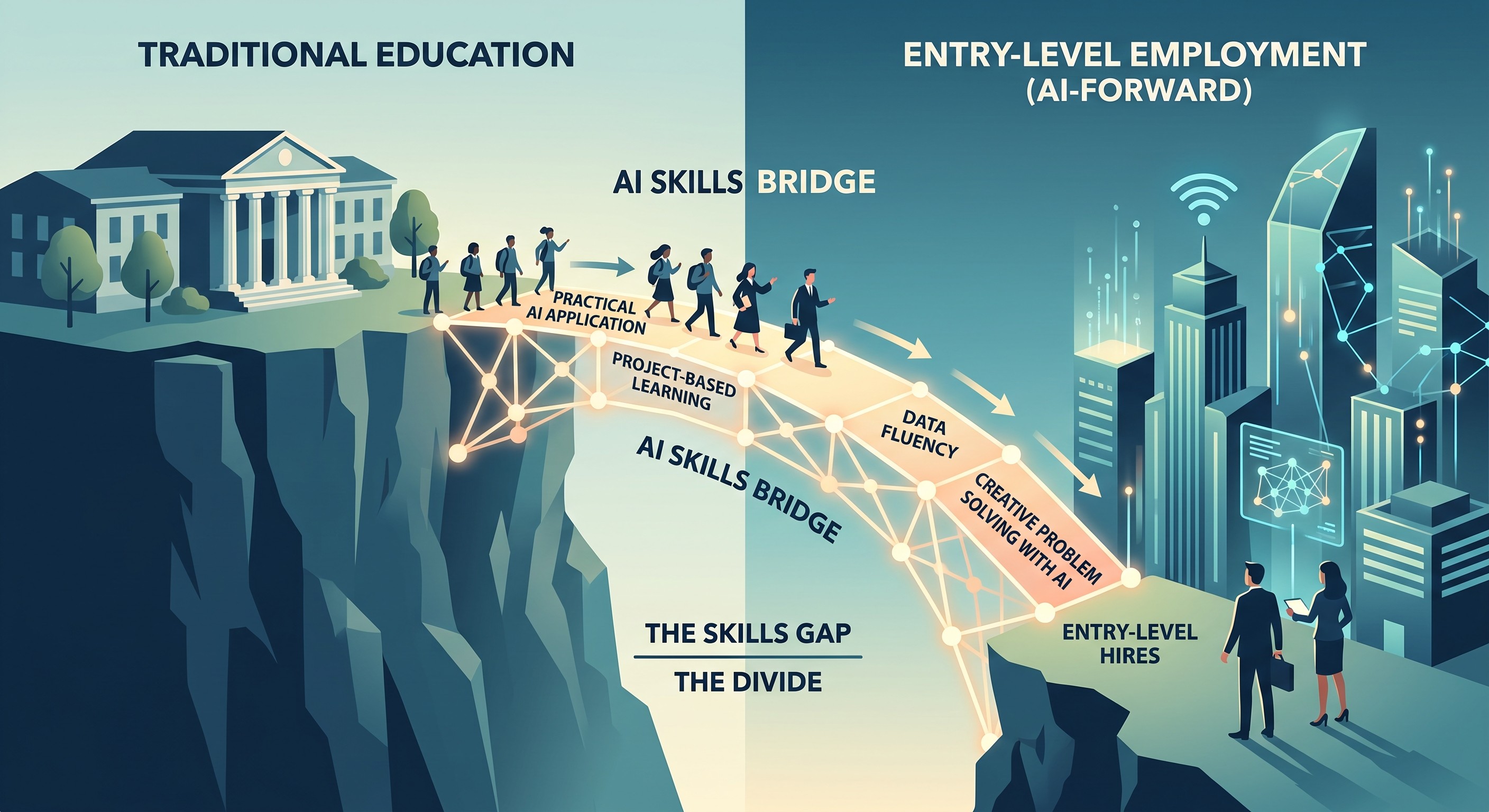
Pull the week's threads together and a single theme emerges: the distance between what education prepares students for and what employers actually need on day one is not growing because employers are hiring less — it's growing because the shape of the work is changing faster than the curriculum. Employers in the Strada data say they want more analytical thinking and better judgment from entry-level hires; the Handshake data shows AI keywords in job postings nearly doubling year-over-year; and the Dallas Fed research shows the front door to AI-exposed careers quietly narrowing for 20-to-24-year-olds who haven't yet built those skills. Meanwhile, at the macro level, claims are at a 57-year low and openings are holding above seven million — this is not a collapsing labor market. It's a restructuring one, and restructuring markets reward preparation. That's where Jobspeaker and its education and employer partners come in. The DOL's move to embed AI skills into Registered Apprenticeships, the wave of state legislation building AI governance into schools, and the growing corporate "learning debt" problem all point toward the same conclusion: the connective tissue between learning and earning has to be rebuilt for an AI-shaped economy, and no single institution can do it alone. Together — colleges, K-12 systems, employers, and platforms like Jobspeaker — we can map what's actually being asked of new workers, close the gap before it widens further, and make sure the next generation of jobseekers walks in the door ready for the role as it actually exists today, not as it existed five years ago.