AI
The AI Skills Gap Trapping Graduates and Mid-Career Workers
Jobspeaker
September 29th, 2026
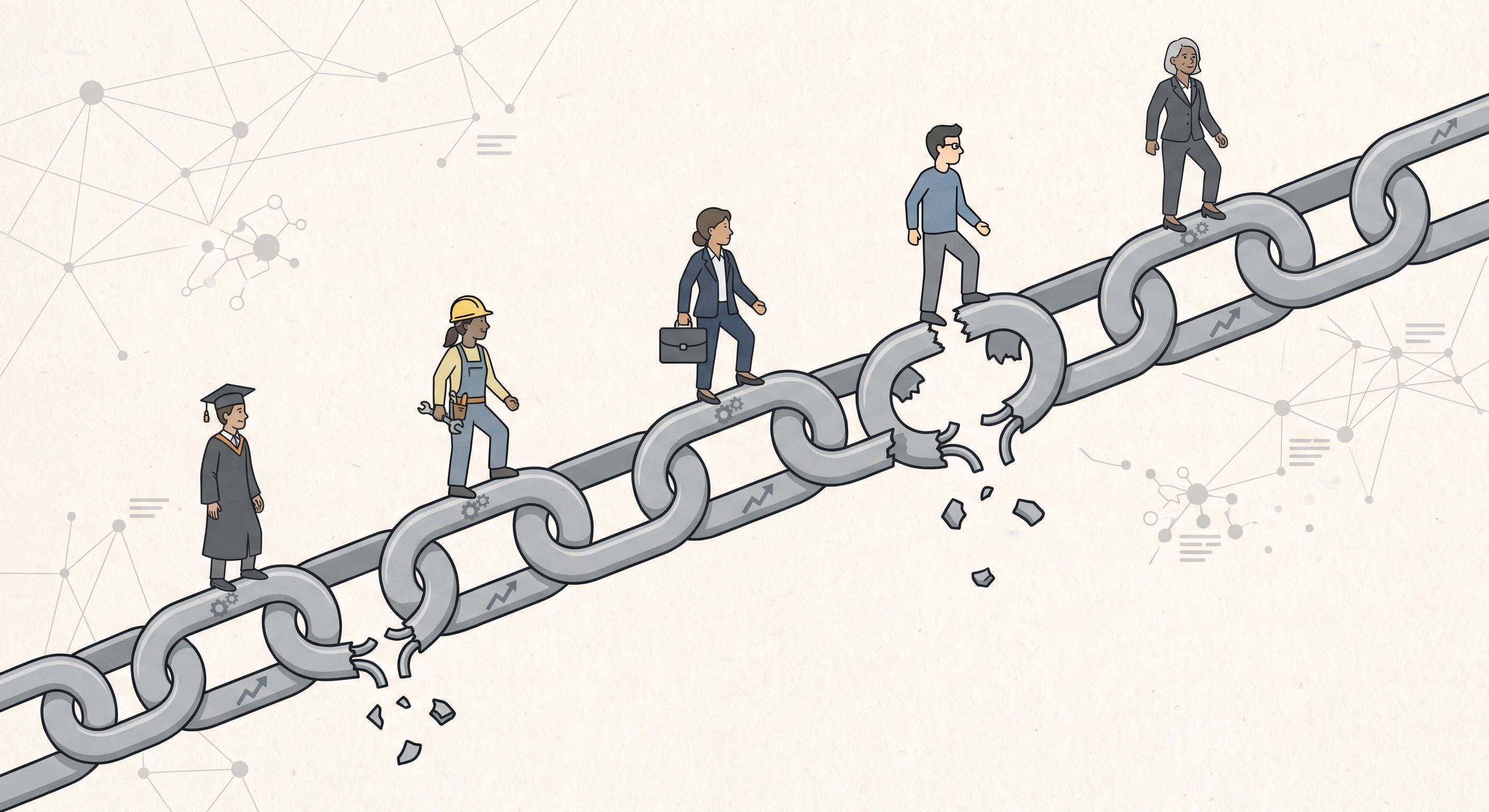
New data shows only 28% of 2026 graduates got real AI training, while 1 in 4 mid-career workers are stalled. Here's what the gap means for educators and employers.
The AI Skills Gap Trapping Graduates and Mid-Career Workers
New data shows only 28% of 2026 graduates got real AI training, while 1 in 4 mid-career workers are stalled. Here's what the gap means for educators and employers.
🔭 The Big Picture This Week
A new joint report from NYU SPS and the Burning Glass Institute finds that one in four mid-career professionals are stranded in a "career stall," a point where advancement has plateaued and skills have fallen out of alignment with employer demand. That finding arrives alongside the Class of 2026 Graduation Report, which shows only 28% of graduating seniors say their program meaningfully integrated AI into coursework, even as employer demand for AI skills in full-time entry-level postings has nearly doubled year-over-year. The two data points trace a career arc worth taking seriously: graduates arrive underprepared, and without deliberate reskilling at the job or a return to learning, many carry that gap forward into the mid-career stall the NYU/BGI data documents.
💬 Our Take
The education-to-work pipeline has a gap at both ends right now: new graduates entering without the AI fluency employers expect, and experienced workers finding that early training is ageing out faster than employers are replacing it. We think colleges and employers can close both gaps together, and that shared playbook is precisely where Jobspeaker operates.
📊 Macro & Economic Context
Jobless Claims Near a 57-Year Low, But the Re-Employment Picture Is More Complex | DOL / Reuters
Initial claims for the week ending September 19 slipped to 197,000, below the Reuters consensus forecast of 201,000 and near the lowest levels since the late 1960s. Continuing claims, which reflect how long displaced workers are taking to find new work, ticked up slightly to 1.719 million for the period ending September 12. The September jobs report covering actual payrolls is due October 2, so this week's claims data is the last labor-market read before that release lands.
Why it matters: Low initial claims confirm that mass layoffs are not the story, but the modest rise in continuing claims is a reminder that finding a new job, particularly for workers whose roles have AI exposure, takes longer than the headline suggests. For recent graduates and career-changers, that re-employment lag is the number to watch.
Read: U.S. Jobless Claims Fall to 197,000, Near 57-Year Low (Yahoo Finance / Reuters) →
🎓 Higher Education
One in Four Mid-Career Professionals Are Stranded in a "Career Stall," NYU SPS and Burning Glass Institute Find | NYU SPS
A new report from NYU's School of Professional Studies and the Burning Glass Institute finds that roughly one in four mid-career professionals have hit a prolonged plateau, with advancement stalled and skills increasingly misaligned with what the market now demands. The research identifies targeted internal mobility as one of the most effective remedies: workers who transition into adjacent, higher-demand roles within the same employer can cut their stall risk dramatically. Credentials that are market-aligned and high-quality also correlate with fewer stalls and better recovery when they do occur.
Why it matters: For educators and workforce programs, this is a reminder that the education-to-work relationship does not end at graduation. The same investment in career-relevant skills that helps new graduates land well also determines whether they advance a decade later.
Read: One in Four Mid-Career Professionals Are Stranded in Career Stall (NYU SPS) →
Cengage 2026 Employability Report: 92% of Instructors Say AI Skills Are Essential, Yet 58% Think Graduates Are Less Prepared Than a Decade Ago | Cengage Group
Cengage's 2026 Employability Report, drawn from instructor perspectives across U.S. higher education, finds 92% of faculty believe it is important to include AI skills and literacy in coursework. Yet 58% of those same instructors say today's graduates are less prepared than those from ten years ago, citing declines in critical thinking, communication, and work ethic, even as reliance on technology increases. The report frames the disconnect not as a crisis but as a signal to rethink how preparation is structured for an AI-enabled workforce.
Why it matters: Faculty are not unaware of the shift; they're working through it in real time alongside their students, and the data shows they want to close the gap. Institutional support for curriculum redesign and AI pedagogy is the resource they need most.
Read: How AI Is Reshaping Workforce Readiness in Higher Education (Cengage Group) →
💼 Labor Market & Jobseekers
Handshake Class of 2026 Report: Employer AI Demand Has Nearly Doubled, But Only 28% of Graduates Say School Delivered | Handshake
Handshake's Class of 2026 Graduation Report documents a widening gap between what employers now expect and what colleges are delivering on AI. The share of full-time entry-level postings mentioning AI skills has nearly doubled year-over-year to 4.2%, while more than 10% of active internships now carry AI keywords. Students moved faster than their institutions: 85% of the Class of 2026 uses AI, with more than a third doing so daily, up from close to half of the Class of 2024 reporting they had never used it. Yet only 28% say their program meaningfully integrated AI, and 58% say they will need stronger AI skills to succeed at work than their education gave them.
Why it matters: The gap between student AI fluency and institutional AI curriculum is not a failure of students; it is an opportunity for colleges and career services to catch up fast, and employers who partner with campuses now on AI skill-building will be better positioned to hire confidently from the Class of 2027.
Read: Class of 2026 Graduation Report (Handshake) →
Skills-Based Hiring's Promise and Its Gap: 85% of Employers Claim to Use It, But Nearly All Actual Hires Still Require Degrees | CTO Magazine / Harvard Business School / Burning Glass Institute
A sharp new analysis finds that while 85% of employers report using skills-based hiring, joint research from Harvard Business School and the Burning Glass Institute shows only about 0.14% of actual annual U.S. hires went to candidates without a college degree. Critically, only 37% of companies that formally dropped degree requirements actually increased their hiring of non-degree candidates. The NACE Spring 2026 Update adds nuance: projected hiring for the Class of 2026 bumped up to a 5.6% increase, but the entry-level market remains genuinely competitive and the gap between stated hiring philosophy and actual practice persists.
Why it matters: Skills-based hiring is a real and important trend, but credential-holders and learners should not be misled by the rhetoric. For Jobspeaker's learners pursuing alternative credentials, demonstrating applied skill clearly and early in the hiring process remains the best way to close the policy-practice gap.
Read: Skills-Based Hiring and How Recruitment Is Changing in 2026 (CTO Magazine) →
🏢 Corporate Training & Reskilling
Only One in Three Workers Received Employer AI Training in the Past Six Months, The Gap Between AI Adoption and AI Enablement Is Now L&D's Defining Problem | Devlin Peck
A comprehensive review of 2026 corporate learning data finds that despite more than $400 billion invested annually in corporate training, only about a third of workers have received employer-provided AI training in the past six months. At organizations where AI has been deployed, HR professionals report far more upskilling activity than job displacement, which is encouraging, but three in four employees say their employer has never communicated a clear AI plan. The Josh Bersin Company's 2026 research argues that traditional e-learning and video courses are no longer sufficient and that AI-delivered training built from current company knowledge better meets today's pace of change.
Why it matters: The problem is not investment; it is reach. Employers who can connect structured AI training to employees' day-to-day roles, rather than leaving upskilling to self-direction, will close skills gaps faster. Community college and workforce program partners are natural allies in building that bridge for workers who cannot wait for the corporate L&D cycle to catch up.
Read: AI in Corporate Training Statistics for 2026 (Devlin Peck) →
Burning Glass Institute Selects Six Organizations for Its 2026 Skills First Implementation Fellowship | Burning Glass Institute
The Burning Glass Institute has named six organizations to its 2026 Skills First Implementation Fellowship and Regional Skills First Implementation Pilots, initiatives designed to move shared skills standards from research into live hiring, training, and workforce systems. The cohort builds on the broader Skills-First Workforce Initiative, with the goal of embedding common skills taxonomies into the tools and systems that actually shape who gets hired and how workers advance. Regional pilots are a deliberate part of the design, recognizing that national standards only work if local employers and training providers can implement them.
Why it matters: Translating skills-based frameworks from policy documents into actual hiring decisions is where most initiatives stall. These implementation fellowships are an attempt to close that execution gap, and the regional pilot structure is a model worth watching for workforce programs trying to make skills-first hiring real at the local level.
Read: Burning Glass Institute 2026 Skills First Implementation Fellowship (BGI) →
🏫 K-12 & Policy
Idaho Adopts a Statewide K-12 GenAI Framework With Grade-Band AI Literacy Standards | Idaho State Board of Education / Playlab Learning Hub
Idaho's State Board of Education approved a statewide generative AI framework in mid-August 2026, developed in response to SB 1227 enacted earlier in the year. The framework defines AI literacy competencies by grade band, from K-2 through 9-12 and beyond, with principles centered on human-centered oversight, transparency, safety, and data security. Local districts and charter schools are expected to adopt aligned policies. Companion K-12 AI academic standards remain in draft form, with final approval expected before the 2027-28 school year.
Why it matters: Idaho adds to the growing roster of states moving from district-level patchwork to statewide frameworks. The grade-band structure matters: AI literacy defined at K-2 level is a very different commitment than a high school elective, and setting expectations early gives districts, teachers, and curriculum developers a shared target to build toward.
Read: AI State Policies, Idaho and the National K-12 Policy Landscape (Playlab Learning Hub) →
🎯 Why It Matters for Jobspeaker
This week's stories, taken together, point to a structural problem that sits right at the heart of what Jobspeaker does. Graduates arrive at the workforce with AI fluency they largely developed on their own, because only 28% say their college program delivered it. Entry-level employers are now explicitly demanding those skills, with postings nearly doubling year-over-year. Mid-career workers, meanwhile, face a separate but related pressure: the NYU SPS and Burning Glass data shows that a quarter of them are already in a career stall, often because the skills they built early in their careers are ageing out faster than their employers are replacing them. And on the employer side, $400 billion a year in corporate training is not reaching most workers on AI. The through-line across all of this is a coordination failure, not a motivation failure. Educators want to prepare students for AI-shaped work. Employers want skilled talent. Workers at every career stage want to stay relevant. What's missing is the connective tissue: shared standards, clear signals about what skills matter for which roles, and structures that let learning happen in context rather than in isolation from the work itself. That connective tissue is what Jobspeaker is built to provide, working alongside educators, employers, and workforce partners to make the education-to-employment path legible, navigable, and real for every learner.