Education, Workforce
Workforce Pell Is Live—Here's What It Actually Changes
Jobspeaker
September 8, 2026
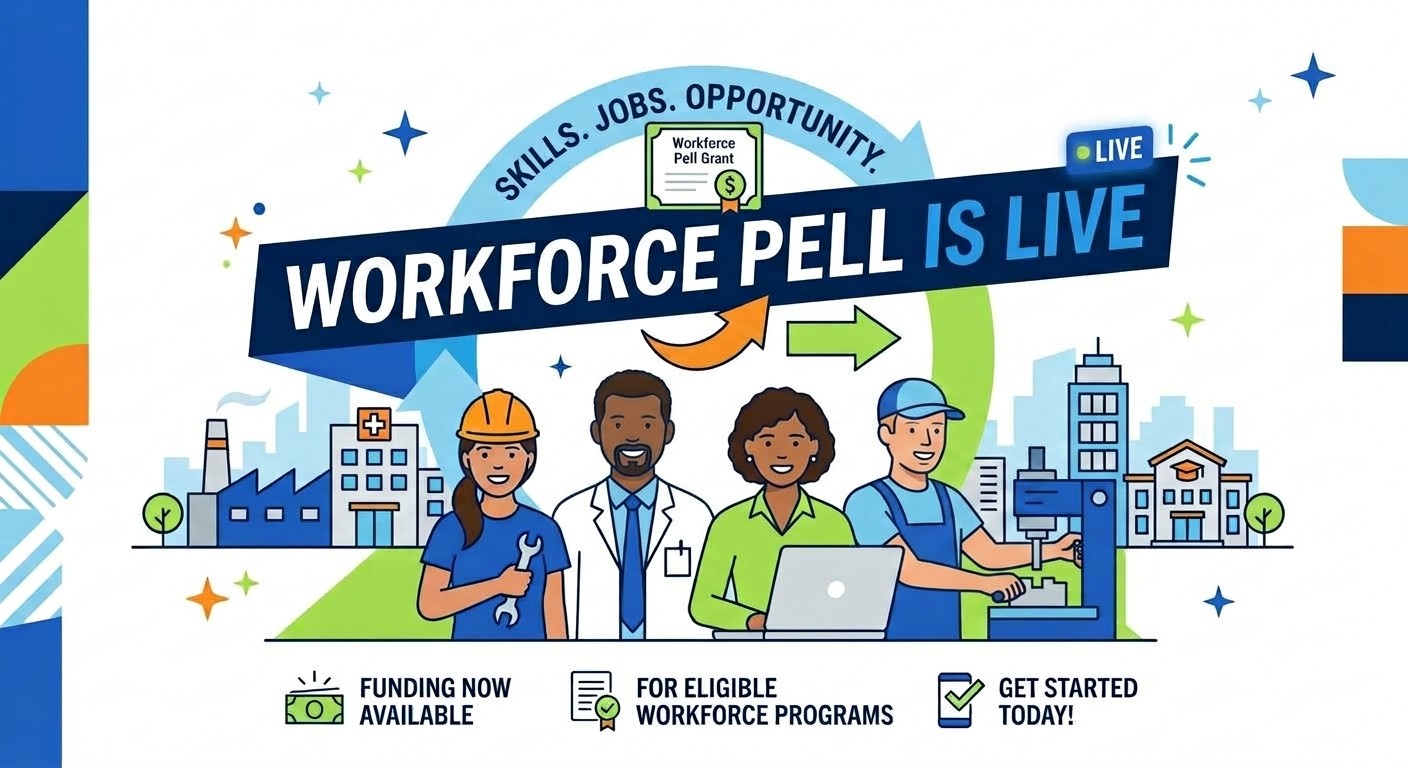
Workforce Pell unlocks federal aid for 8–15 week credentials. Here's what it means for educators, employers, and the students caught in the middle.
Workforce Pell Is Live—Here's What It Actually Changes
Workforce Pell unlocks federal aid for 8–15 week credentials. Here's what it means for educators, employers, and the students caught in the middle.
For decades, the most persistent structural problem in American workforce development wasn't a lack of good training programs—it was a funding gap that made those programs inaccessible to the people who needed them most. Adult learners returning to the workforce, first-generation students who can't afford a two- or four-year detour, career changers who know exactly what skill they need but can't pay for six weeks of instruction—all of them have been locked out by a federal financial aid system designed almost entirely around semester-length, degree-granting programs.
That changed on July 20, 2026. Quietly, without a splashy launch event, Workforce Pell cleared its final implementation hurdles and became live federal policy. Programs as short as eight weeks are now eligible for Pell Grant funding—provided they meet strict outcomes accountability thresholds. It is not an exaggeration to call this the most consequential structural change to federal workforce education funding in a generation. But the policy's real impact depends almost entirely on what educators, employers, and workforce partners do with it in the next 12 to 24 months.
What Workforce Pell Actually Does—and Doesn't Do
The mechanics matter here. Under the new rule, federal Pell Grant aid can now be applied to workforce training programs lasting between 8 and 15 weeks, explicitly designed to prepare learners for employment. That's the headline. But the accountability structure underneath it is where the policy gets serious—and where it diverges sharply from anything the federal government has tried before.
To remain eligible, institutions must satisfy a 70% program completion rate and a 70% job placement rate within six months of exit. Both thresholds must hold simultaneously. There's no averaging across programs, no grace period for new offerings. If a program can't demonstrate that seven in ten students finish and seven in ten find employment within six months, it loses access to federal funding.
That accountability structure is not a burden—it's a signal. It tells educators exactly what the federal government, and by extension the labor market, now considers the minimum bar for a publicly subsidized credential. Completion and employment. Not seat time. Not credit hours. Outcomes.
For community colleges, CTE programs, and workforce training providers who have spent years building employer-aligned short-cycle programs without access to federal funding, this is validation and opportunity at once. For institutions that have been slower to build those feedback loops with local employers, it's an honest nudge toward a conversation that's long overdue—and one that Jobspeaker and workforce partners across the country are ready to help facilitate.
Why the Timing Is Not a Coincidence
Workforce Pell didn't arrive in a vacuum. It arrived in the same month that AI was confirmed as the leading cumulative cause of announced U.S. job cuts in 2026, with more than 102,000 announced layoffs attributed to AI through the first eight months of the year—already surpassing the total for all of 2025. It arrived as the information sector—the industry with the highest AI adoption rate in the U.S. economy, at 39.7% of firms—shed 23,000 jobs in August alone, nearly triple its prior 12-month average monthly loss.
The labor market is not collapsing. The August jobs report showed 162,000 nonfarm payrolls added, and layoffs are at a four-year low. But the jobs being added and the jobs being eliminated are increasingly in different sectors, requiring different skills, and rewarding different credentials. The four-year degree pipeline—built around information-sector and finance-sector career tracks—is flowing toward industries that are contracting at an AI-accelerated pace.
This is precisely the environment Workforce Pell was designed for. When the skills the economy needs change faster than a traditional degree program can update its curriculum, a federally funded 10-week credential becomes not a consolation prize but a strategic tool. The question is whether institutions can build, validate, and sustain programs that meet the new accountability thresholds—and whether employers will show up as genuine partners in defining what those programs should contain.
The encouraging answer, based on this week's data, is that both sides are moving. SHRM's 2026 Talent Trends research found that 68% of organizations report difficulty filling roles, and 53% say recruiting has become more difficult compared with a year ago. Employers are not passive observers of the credential ecosystem—they're experiencing the skills gap as a daily operational problem. Workforce Pell gives them a federally subsidized pipeline to help solve it, if they engage now.
The Second-Order Effects on the Education-to-Work Pipeline
The most immediate effect of Workforce Pell is financial access: adult learners and career changers who previously couldn't afford short-cycle training now have a federal funding pathway. But the second-order effects on the education-to-work pipeline are arguably more significant.
First, the 70/70 accountability thresholds will accelerate a sorting process that was already beginning. Programs with strong employer partnerships, clear labor market alignment, and robust student support systems will thrive under this framework. Programs that were built around institutional convenience rather than learner outcomes will face real pressure to change or close. That's a hard truth, but it's also an invitation—because the institutions best positioned to meet those thresholds are often the community colleges and CTE providers that have been doing this work for years without federal recognition or funding. Workforce Pell gives them both.
Second, the policy shifts the implicit definition of what counts as a legitimate credential. When the federal government funds an eight-week program with the same Pell Grant mechanism it uses for associate degrees, it sends a message to employers, learners, and the broader public: completion of a short-cycle, outcomes-verified program is a meaningful signal of job readiness. That normalization matters. A 2026 Lumina-Gallup report found that only about half of employers believe colleges are graduating students with the skills their organizations need, and 69% report that recent hires require moderate or significant additional training. In that environment, a credential backed by a 70% employment outcome rate may carry more signal than a degree backed by none.
Third—and this is where educators and workforce platforms can do the most good together—Workforce Pell creates a new kind of employer engagement imperative. The job placement threshold can't be met without active employer relationships. That means institutions need real-time labor market intelligence, established recruiting pipelines, and structured feedback from hiring managers about what competencies actually matter. It means career services and academic affairs have to work from the same map. It means the wall between education and employment—never more than a useful fiction—now has a financial incentive to come down entirely.
What Educators and Employers Can Do Right Now
The policy is live. The funding mechanism exists. The accountability thresholds are set. What remains is implementation—and that's where the partnership between educators, employers, and workforce platforms becomes decisive.
For educators and training providers, the first step is audit: which of your existing short-cycle programs are candidates for Workforce Pell eligibility? Which already have employer relationships strong enough to support a 70% placement rate? Which need to be rebuilt around genuine labor market demand rather than historical program design? Hiring managers report that on-the-job training (67%) and industry-recognized certifications (61%) are the most effective ways to build AI skills—and the fastest-growing entry-level roles, including AI Security and Risk Analyst, Junior Data Scientist, and AI Governance and Compliance specialist, represent exactly the kind of targeted, employer-defined competency frameworks that short-cycle programs can build around.
For employers, the opportunity is concrete: engage now with the community colleges, CTE programs, and workforce providers in your region that are building Workforce Pell-eligible programs. Your participation in curriculum design, your commitment to interview pipelines, and your willingness to provide placement data are not charitable acts—they're what makes the funding mechanism work and the talent pipeline flow toward your organization.
For both, the shared goal is the same one that Workforce Pell was built to serve: a faster, more affordable, more accountable pathway from learning to livelihood, at exactly the moment the labor market is demanding it most. The infrastructure is in place. The opportunity is real. And the outcomes—for learners, for institutions, and for employers navigating an AI-reshaped economy—are worth building toward together.
Next article