Education
The Student Who Teaches Themselves AI (and What's Lost)
Jobspeaker
October 15th, 2026

Students are adopting AI faster than colleges can govern it. Here's what that means for the education-to-work pipeline, and what educators can do now.
Eighty-eight percent. That is the share of students who now use AI in their learning, according to the Digital Education Council's 2026 Global Survey, which drew on 45,398 responses from students and faculty across 35 countries. Faculty adoption reached 77%, up 16 percentage points on 2025, which sounds like progress. But underneath both numbers sits a more uncomfortable finding: only 29% of students believe their instructors are equipped to guide them on AI use, and only 28% feel their assessments reflect the skills they expect to need once they graduate.
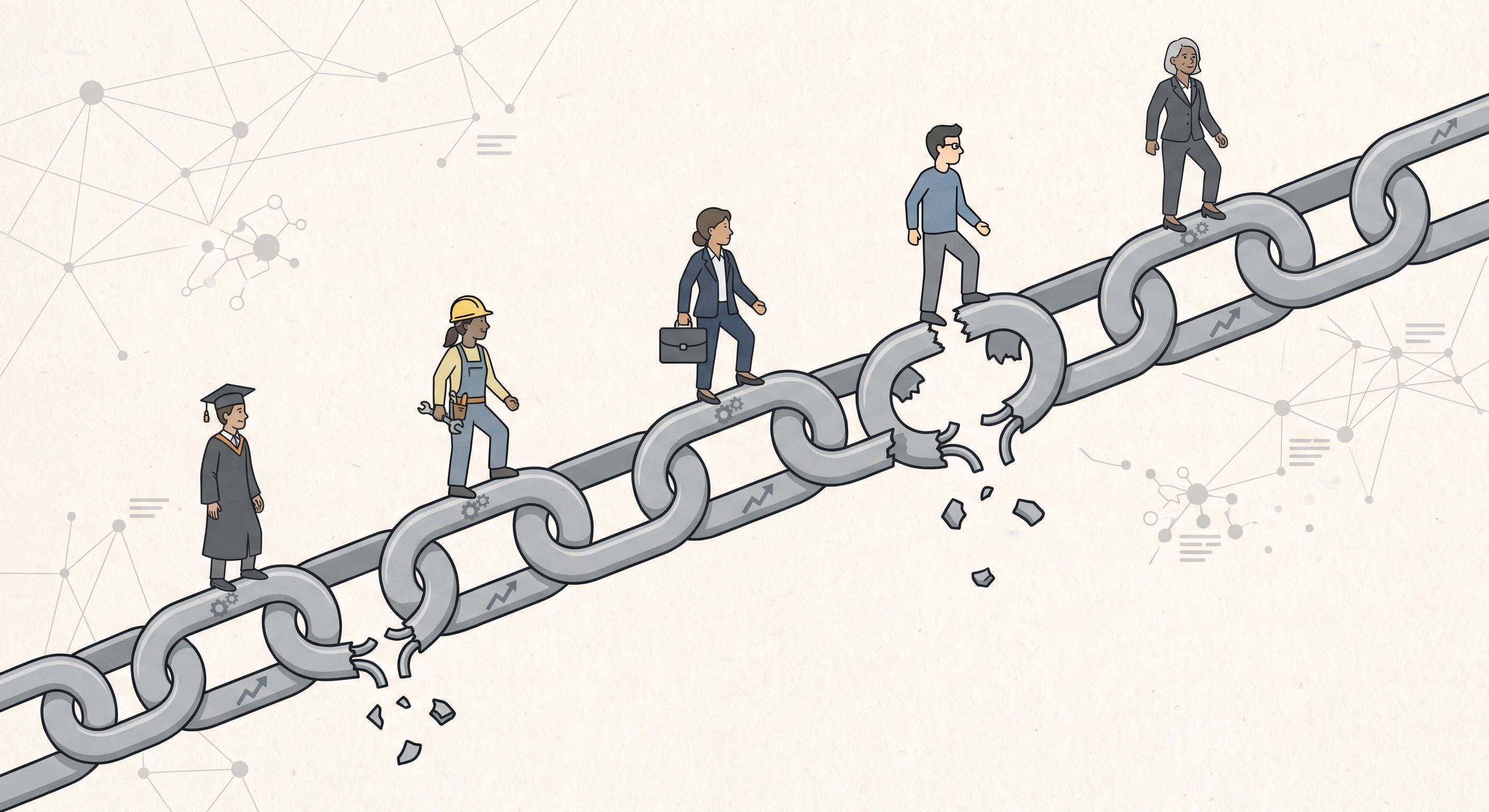
Students are not waiting for their institutions to catch up. They are building their own AI practices, largely unsupervised, often without feedback, and in ways that employers may or may not value. That is the thread worth pulling this week, because the consequences for the education-to-work pipeline run deeper than a skills gap. They touch on what learning is actually for, and what gets lost when students race ahead of the structures designed to guide them.
Usage Without Guidance Is Its Own Problem
There is a version of this story that reads as encouraging. Students are digitally curious and self-directed. They are adopting tools that employers increasingly demand. PwC's 2026 AI Jobs Barometer, analyzing more than one billion job postings across 27 countries, found that roles requiring AI skills are growing nearly eight times faster than the overall job market. Getting familiar with AI tools early is genuinely useful.
But 57% of students in the Digital Education Council survey say their assessments come with inadequate AI guidance. That means more than half of students are making judgment calls about when to use AI, how to use it, and what to put their own name on, without any structured framework from the people best positioned to help them think it through. The result is not a generation of confident, AI-fluent graduates. It is a generation that has learned to produce outputs with AI assistance but may not be able to explain what they did, defend their reasoning, or demonstrate independent judgment to a skeptical hiring manager.
Twenty-two percent of students in the survey already report finding it harder to work without AI tools than they did a year ago. That figure deserves some careful attention. Dependence is not the same as capability, and the distinction matters enormously in a hiring environment where entry-level AI-exposed roles are now seven times more likely to require skills traditionally associated with senior employees: judgment, leadership, creative problem-solving, relationship-building. Those are precisely the capacities that get built through productive struggle, through doing hard things without a shortcut.
The North American Signal Worth Watching
The regional breakdown in the Digital Education Council data is one of the more striking findings in an already striking dataset. In the US and Canada, faculty intent to use AI in teaching dropped 9 percentage points, from 76% to 67%, leaving North America with the lowest future adoption intent of any region surveyed globally.
That is not a indictment of educators here. Faculty are navigating real pressures: workload, institutional policy uncertainty, academic integrity concerns, and the honest reality that AI tools are evolving faster than professional development programs can track them. The EDUCAUSE 2026 conference in Denver, attended by more than 7,000 higher education technology and academic leaders, named "determining where AI adds real value" as its single top priority for 2027, based on a survey of 882 technology leaders across hundreds of institutions. When that question is still being worked out at the organizational level, individual faculty members are in a genuinely difficult spot.
The gap this creates, however, is real. Students in North American institutions are using AI at high rates without corresponding faculty guidance, at exactly the moment when employers are making AI literacy a condition of competitive hiring. The institutions best positioned to help are the ones where faculty and administrators work through the AI question together, with time and support to do it properly, rather than leaving individual instructors to figure it out course by course.
What Employers Are Actually Asking For
A Study.com survey of hiring managers on the fastest-growing entry-level AI roles for 2026 found that on-the-job training (67%) ranked as the best way to build AI skills, ahead of certifications (61%) and university coursework (58%). Nearly half of respondents said education and portfolio are equally important, while only 6% think education matters more than portfolio on its own.
It would be easy to read that as a verdict against higher education. It is not. It is a description of a structural mismatch: the academic calendar, the assessment cycle, the pace at which curriculum gets revised are all slower than the pace at which AI tools and employer expectations are moving. That is not a failure of will. It is a feature of institutions built for durability, for transmitting knowledge that holds up over time, now being asked to respond to a skills environment that is rewriting itself annually.
The Study.com data also found that the biggest anticipated talent shortages are in AI Governance and Compliance (52%), Robotics and Automation (70%), and Generative AI (67%). Governance and compliance, notably, are areas where the analytical, ethical, and communication skills that universities are genuinely good at building are directly relevant. The challenge is connecting those existing strengths to the specific contexts employers have in mind, which is where partnerships between institutions and employers become genuinely functional rather than ceremonial.
Closing the Loop Before Students Close It Themselves
The risk in the current moment is not that students are using AI. It is that they are building AI habits in a vacuum, habits that may or may not translate to workplace capability, and that the credential they earn may not reflect what they actually know how to do. When 28% of students feel their assessments reflect real-world AI-era skills, the credential-to-career signal is weakening at exactly the moment employers are raising the bar.
The institutions that will navigate this well are the ones investing now in faculty AI fluency, in assessment redesign that can distinguish between AI-assisted output and AI-augmented thinking, and in tighter feedback loops with employers about what entry-level readiness actually looks like today. EDUCAUSE President John O'Brien said at the Denver conference that he expects higher education broadly to adopt the workforce attitudes long associated with career and technical institutions, a genuine shift in how four-year schools have historically thought about their relationship to the labor market.
That shift is an opening. Educators already understand their students better than any employer or platform does. What they need alongside that understanding is real-time signal from the hiring side, specific, current, employer-sourced data on what AI capability looks like in practice across different fields and roles. With that signal, curriculum decisions, capstone designs, co-op structures, and career services conversations can all move in a more useful direction. The students who are teaching themselves AI right now deserve a system that meets them with that kind of guidance, not just usage policies and honor codes. There is a real opportunity here, and it is one that educators, employers, and the platforms connecting them are far better positioned to act on together than any one of them is alone.