AI
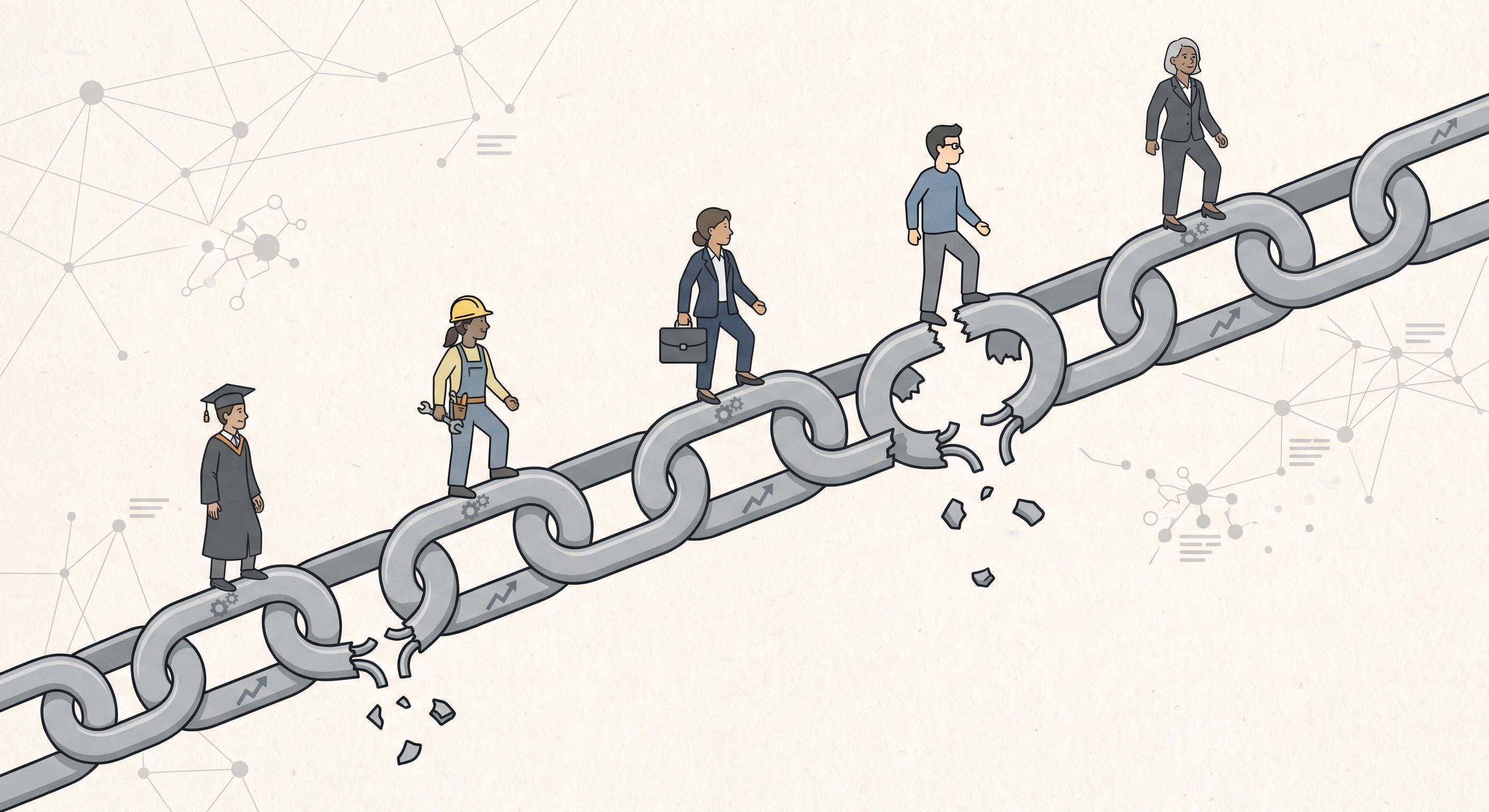
AI Skills Now Command a 62% Wage Premium—and Grads Aren't Ready
Jobspeaker
October 13th, 2026

EDUCAUSE, PwC, and hiring managers reveal the same gap from three angles: AI capability is reshaping entry-level work faster than education can respond.
🔭 The Big Picture This Week
At EDUCAUSE 2026 in Denver last week, more than 7,000 higher education technology and academic leaders published their priorities for the coming year. The organization's "2027 Top 10", built from a survey of 882 technology leaders across hundreds of institutions, opened with two items: determining where AI adds real value, and future-proofing students for a volatile world. The institutions responsible for preparing the next generation of workers are still working out, at the highest organizational level, what AI is genuinely worth doing inside their own operations. That is not a criticism; it is an honest account of where higher education stands right now. What gives it urgency is the labor market context sitting alongside it: weekly jobless claims for the week ending October 3 came in at 197,000, and economists are describing the moment as "low-hire, low-fire," with employers holding onto existing workers but staying hesitant to add headcount. Students and new grads are trying to enter that market while the skills expectations around them keep rising.
💬 Our Take
EDUCAUSE's top two priorities, understanding where AI adds real value and future-proofing students, are the same challenge viewed from two directions. Institutions that get clear on how AI helps their own work will be better placed to prepare students for an AI-shaped workplace.
The PwC data we cover below sharpens the stakes: a 62% wage premium separates AI-skilled from non-AI-skilled workers today, and entry-level roles in AI-exposed fields are increasingly demanding senior-level judgment on day one.
We see this as a moment to work more closely alongside educators and workforce partners, connecting real employer signal to what learners are actually building in classrooms and training programs.
📊 Macro & Economic Context
The Labor Market Is Frozen at the Top, and That's the Problem for New Entrants | DOL / Reuters
Initial jobless claims for the week ending October 3 came in at 197,000, down 2,000 from the prior week and below the 200,000 consensus forecast. On its face, that sounds stable, but the mechanism underneath it matters for anyone trying to get a first job. Economists are calling this a "low-hire, low-fire" market: employers are hoarding workers against a backdrop of economic uncertainty (compounded by commodity price pressures) and have remained hesitant to add headcount even as profits stay strong. Continuing claims edged up 17,000 to 1.716 million for the week ending September 26, a reminder that the people who do fall out of jobs are taking longer to land somewhere new.
Why it matters: A market that isn't firing also isn't creating many new openings, which hits entry-level and early-career candidates hardest, precisely the group that needs practice roles to build the judgment AI-era employers increasingly expect.
Read the Reuters / US News report →
🎓 Higher Education
EDUCAUSE Names "Age of Perpetual Change" as the Frame for 2027, and Puts Student Future-Proofing on Its Top 10 | Inside Higher Ed
More than 7,000 educators, IT professionals, and vendors gathered in Denver for EDUCAUSE 2026, the ed-tech sector's largest annual conference. Senior Director of Research Mark McCormack unveiled the 2027 EDUCAUSE Top 10 at the event, calling this "the age of perpetual change." The list was built from expert panel input and a survey of 882 technology leaders across hundreds of institutions. The top two priorities were determining where AI adds real value and future-proofing students for a volatile world. EDUCAUSE President John O'Brien added that he expects higher education broadly to adopt the workforce attitudes long associated with career and technical institutions, and that employers are now telling him they would rather hire someone with AI experience over a candidate without it, whatever their degree.
Why it matters: When higher education's own technology leaders put "preparing students for a volatile world" as a top priority rather than a given, it signals that the curriculum-to-career alignment problem is being felt inside institutions, not just by employers looking at graduates from the outside.
Read the Inside Higher Ed report →
Global Survey of 45,000 Finds Students Outpacing Their Institutions on AI, and Starting to Lose Skills in the Process | Digital Education Council / EdTech Innovation Hub
The Digital Education Council's AI in Higher Education Global Survey 2026, drawing on 45,398 responses from students and faculty across 35 countries, found that 88% of students now use AI in their learning, while faculty adoption reached 77%, up 16 percentage points on 2025. But the infrastructure around that adoption is lagging badly. Only 29% of students believe their instructors are equipped to guide them on AI use, 57% say their assessments come with inadequate AI guidance, and only 28% feel their assessments reflect the skills and judgment they expect to need in an AI-enabled workplace. In the US and Canada specifically, faculty intent to use AI in teaching dropped 9 percentage points from 76% to 67%, leaving the region with the lowest future adoption intent globally. There are early signs of dependence too: 22% of students say they find it harder to work without AI tools than they did a year ago.
Why it matters: Students are adopting AI faster than their institutions can govern or teach it, which means the gap between what grads have actually learned to do with AI and what employers need from them may be widening even as usage rates climb.
Read the full analysis at EdTech Innovation Hub →
💼 Labor Market & Jobseekers
PwC's AI Jobs Barometer: A 62% Wage Premium, Entry-Level Roles That Expect Senior Judgment, and a Labor Market Dividing Into Two Tracks | PwC / HRTechEdition
PwC's 2026 Global AI Jobs Barometer, analyzing more than one billion job advertisements across 27 countries, finds that the average wage premium for AI skills has climbed to 62%, up from 57% in 2025, and as high as 118% in some sectors. Jobs requiring AI skills are growing almost eight times faster (69%) than the overall job market (9%). The most striking finding for early-career workers: an analysis of 2.4 million US entry-level job postings found that AI-exposed roles are now seven times more likely to require skills traditionally associated with senior employees, judgment, leadership, creativity, face-to-face relationship skills. Demand for these "seniorised" entry-level roles has grown 35% since 2019. Every other entry-level category shrank by 10% over the same period. AI is simultaneously removing the routine "grunt work" that used to train junior hires while demanding that those same hires show up with the judgment that routine work was supposed to build.
Why it matters: For anyone designing curricula or career services programs, this is the clearest quantification yet of what the skills bar at entry-level actually looks like, and why a diploma without demonstrated AI capability is losing ground fast.
Read the HRTechEdition analysis → | PwC press release →
Hiring Managers Say On-the-Job Training Beats University for Entry-Level AI Roles, and the Biggest Talent Gaps Are in Governance, Not Just Engineering | Study.com
A Study.com survey of hiring managers on the five fastest-growing entry-level AI roles for 2026 found that on-the-job training (67%) is considered the best way to build AI skills, ahead of certifications (61%) and university coursework (58%). Nearly half of respondents (49%) said education and portfolio are equally important, while only 6% think education matters more than portfolio on its own. The biggest expected talent shortages are in Robotics and Automation (70%), Generative AI (67%), and, notably, AI Governance and Compliance (52%). The fastest-growing entry-level roles include AI Security and Risk Analyst, AI Research Assistant, Junior Data Scientist, Generative AI Content Creator, and Data Annotation Specialist: a mix of technical and non-technical positions that reflects AI reaching across business functions, not just engineering teams.
Why it matters: When hiring managers rank on-the-job training above university coursework for AI readiness, it strengthens the case for work-integrated learning models, apprenticeships, co-ops, project-based partnerships, as the fastest route to closing the entry-level AI gap.
Read the Study.com hiring manager report →
🏢 Corporate Training & Reskilling
The Build vs. Buy Math on AI Talent Is Shifting Sharply Toward Internal Reskilling | TechClass
A detailed TechClass analysis of corporate AI talent strategy finds that companies focusing on skills rather than external degree requirements can grow their AI talent pipeline by 8.2 times. The cost of reskilling is typically a fraction of the cost of recruiting, onboarding, and ramping a new hire. But the case for internal development goes beyond economics: existing employees carry what the analysis calls "contextual intelligence," an understanding of company culture, customers, and hidden processes that is genuinely difficult to transfer. As one finding puts it, it is generally easier to teach a loyal employee with deep institutional knowledge how to use an AI agent than to teach an AI expert how the business works. The "half-life" of specific technical AI skills is now so short that a candidate hired for a 2024 toolset may already be partially obsolete by the time they are fully onboarded.
Why it matters: For workforce educators and training partners, the corporate pivot toward internal reskilling is both a challenge and an opportunity, organizations need structured, employer-aligned learning pathways that can move faster than a traditional degree cycle.
🏫 K-12 & Policy
Nvidia Pauses AI Program With Oregon Schools and Colleges | GovTech
GovTech reported this week that Nvidia has paused its AI program with Oregon schools and colleges. The announcement came alongside EDUCAUSE 2026 coverage, and specific details on the scope and timeline of the pause have not yet been publicly disclosed. The program had been part of a broader wave of technology-company partnerships aimed at embedding AI tools and literacy into K-12 and community college settings in the state.
Why it matters: Corporate AI partnerships in K-12 and higher education are still relatively new, and this is an early-stage signal that they carry implementation and continuity risks that schools need to plan around, even when the technology company is one of the sector's most prominent players.
🎯 Why It Matters for Jobspeaker
Three data points from this week connect into something important for anyone working at the education-to-employment bridge. EDUCAUSE's 7,000 higher-ed leaders said their two biggest priorities are figuring out where AI is genuinely valuable and preparing students for an unpredictable world. PwC's labor market data shows what it costs when that preparation falls short: a 62% wage premium separating AI-capable workers from their peers, and entry-level jobs that increasingly expect the judgment of a mid-career employee from day one. And Study.com's hiring managers said, plainly, that on-the-job training beats university coursework for building the AI skills that matter most right now. Together, those three findings describe the same gap from three different vantage points, the institution, the market, and the employer. The education-to-work pipeline was never a simple handoff, but it is under more pressure than it has been in a long time, and it is being reshaped faster than any single institution can respond to alone. That is exactly why the relationship between educators, employers, and platforms that connect learners to opportunity needs to get tighter, not looser. Jobspeaker exists to help close that loop, giving institutions real-time signal on what employers need, and giving learners a clearer, faster path from credentials to careers, in an economy that is rewriting the rules of both.
Previous article