Article
AI Is Closing the Door on Young Workers—Here's the Data
Jobspeaker
September 1, 2026

Stanford finds a 19% AI-driven employment gap for workers 22–25. Here's what it means for education, hiring, and the future of early-career workers.
AI Is Closing the Door on Young Workers—Here's the Data
Stanford finds a 19% AI-driven employment gap for workers 22–25. Here's what it means for education, hiring, and the future of early-career workers.
🔭 The Big Picture This Week
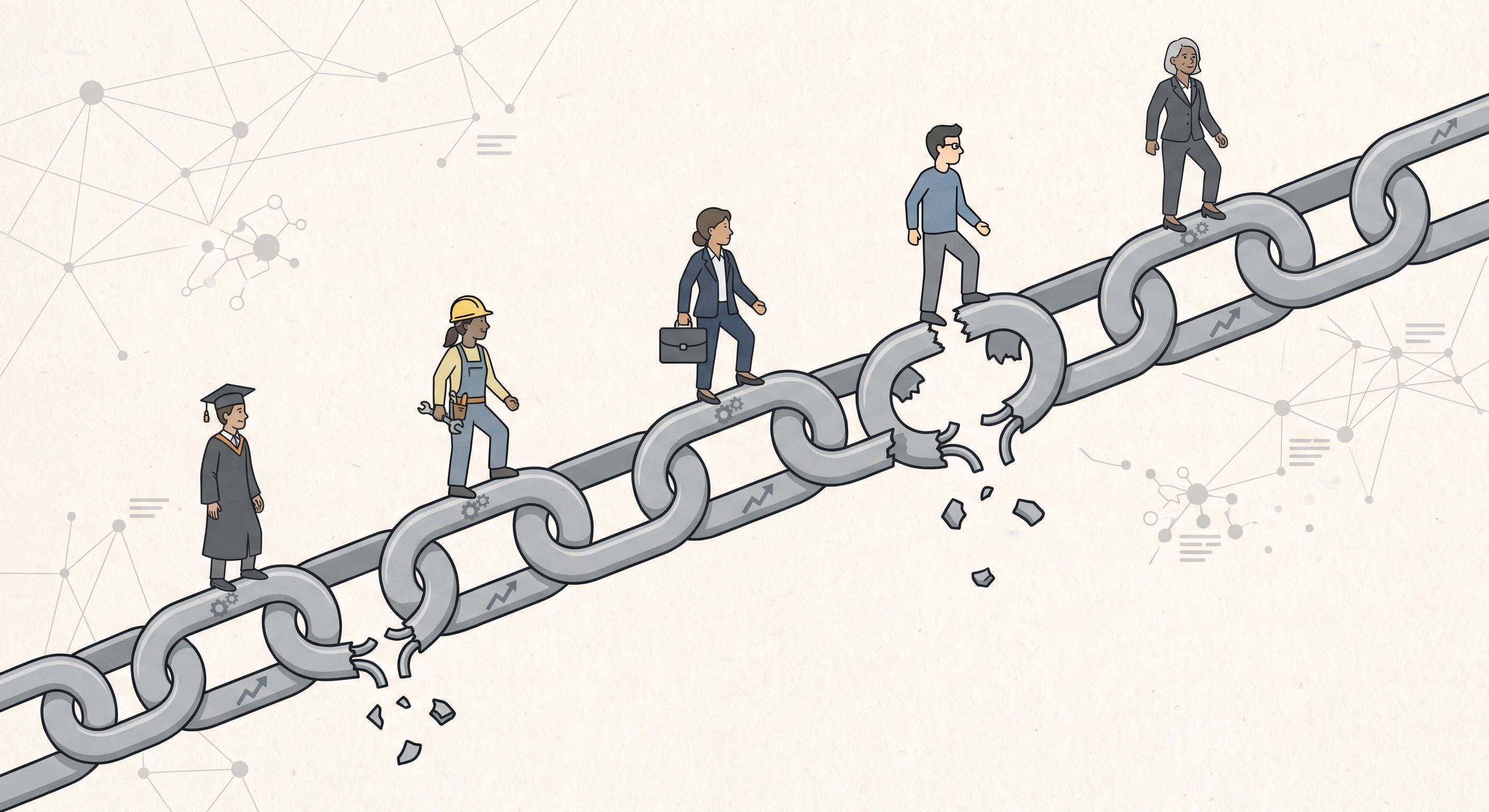
The most urgent data point of the week comes from Stanford University's Digital Economy Lab, whose updated "Canaries in the Coal Mine" report finds that employment among workers aged 22–25 in AI-exposed occupations now stands 19% below where it would be had it kept pace with their less-exposed peers — a gap that has widened steadily and operates primarily through reduced hiring, not layoffs. That finding lands against a backdrop of weekly jobless claims still printing near historically low levels (203,000 for the week ending August 22), yet a labor market that continues to bifurcate sharply by age and skill exposure. At the same time, Florida's DeSantis administration moved this week to regulate AI across the full PreK-to-PhD pipeline, UPCEA released its 2026 Online Education Benchmarking Report calling digital learning at a "consequential point," and teacher apprenticeship programs hit a national milestone — all of it pointing to the same conclusion: the education-to-work pipeline is being rewired faster than most institutions are moving.
💬 Our Take
The Stanford data makes the stakes concrete: AI isn't displacing the whole workforce — it is selectively shutting the door on young, early-career workers who relied on codified, textbook-based skills to get their first foothold. That is precisely the population Jobspeaker exists to serve, and it is exactly why the connection between education quality, credential relevance, and real employer demand has never mattered more. Together with educators, training providers, and employers, we believe the answer is faster feedback loops between the labor market and the classroom — so that what learners are taught today actually opens doors tomorrow.
📊 Macro & Economic Context
Claims Dip to 203,000 for Week Ending Aug. 22 — But the Macro Story Is Bigger Than the Headline | DOL / Trading Economics / FHLBNY
Initial jobless claims fell by 4,000 to 203,000 for the third week of August, coming in below market expectations of 208,000 and holding the trend of low claim counts since dropping to a near 60-year low of 189,000 in mid-July. Analysts note that the dataset's recent trend suggests employer reluctance to lay off workers even as some workers exit the labor force. The headline stability, however, masks a more complicated picture: ADP's monthly private payrolls barometer is expected to dip to roughly 39,000, again signaling a cooling in private-sector hiring momentum. The August Jobs Report (BLS Employment Situation) lands this week — watch it closely for fresh payrolls data that will sharpen the picture considerably.
Why it matters: Low claims mean employers aren't shedding workers broadly — but cooling private hiring signals that finding a new job, or landing a first one, is getting harder, especially for new graduates entering a skills-selective market.
Source: Trading Economics / DOL Initial Claims Data →
💼 Labor Market & Jobseekers
Stanford's "Canaries in the Coal Mine" — Updated August 2026: The AI Employment Gap for Young Workers Widens to 19% | Stanford Digital Economy Lab
Researchers find no evidence of widespread, economy-wide job displacement, but employment of young workers ages 22–25 in AI-exposed occupations now stands 19% below where it would be had it kept pace with their less-exposed peers — and this divergence has widened steadily since it was first documented in August 2025, operating primarily through reduced hiring rather than increased separations. Employment has declined among young workers in occupations that rely heavily on codified knowledge — formal, standardized, documented knowledge that can be taught through textbooks or written procedures — while employment has increased among experienced workers in occupations that rely more on tacit knowledge acquired through practice, mentorship, and repeated exposure. Critically, the Stanford researchers also found that higher education could reduce the employment gap: occupations with a larger proportion of college graduates showed smaller differences in employment outcomes between AI-exposed and less-exposed fields.
Why it matters: The data makes the challenge concrete — AI is not displacing everyone, but it is shutting the on-ramp for early-career workers whose degrees loaded them up on codified knowledge without giving them the tacit, applied skills that make experienced workers irreplaceable.
Source: Stanford Digital Economy Lab →
AI Is Hitting Entry-Level Pay, Too — South Korea and Germany Show the Same Trend Is Global | Ad-Hoc News / Ifo Institute / Bank of Korea
The Stanford gap is not unique to the U.S. The Bank of Korea reported on August 17, 2026 that roughly 295,000 jobs held by 15- to 29-year-olds vanished between June 2022 and June 2026, with 268,000 — fully 94% — in sectors with high AI intensity; the monthly outflow of young workers from those industries climbed 32%, while the inflow dropped 11%. A survey by Germany's Ifo Institute, based on responses from more than 3,000 companies in June 2026, found that 50.8% of firms expect lower salaries for university graduates with under five years of experience — rising to 53.3% in the services sector. By contrast, 26% of businesses anticipate rising wages for seasoned professionals whose expertise is amplified by AI.
Why it matters: When the same wage and hiring squeeze shows up in South Korea, Germany, and the U.S. simultaneously, this is a structural labor-market shift — not a cyclical blip — and it demands a structural response from education systems worldwide.
Source: Ad-Hoc News / Ifo Institute / Bank of Korea →
🎓 Higher Education
UPCEA's 2026 Online Education Benchmarking Report: Digital Learning Has Reached a "Consequential Point" | UPCEA
UPCEA, the online and professional education association, released its 2026 "Benchmarking Online Enterprises" report on August 17, with the third annual study indicating that institutions are centralizing governance, strengthening enterprise-level capacity, and addressing financial issues as online learning becomes part of core academic infrastructure. The report is frank about the pressures institutions face: revenue is growing more slowly than costs across the sector, state funding is contracting, the demographic cliff has arrived, and institutions feeling this most acutely are being asked to spend less and generate more at the same time. The answer the report points toward: colleges and universities must adapt quickly and strategically, embracing data-driven decision-making, flexible credentialing, and deep employer partnerships.
Why it matters: For online and continuing education leaders navigating the AI transition, this report is a benchmark and a call to action — institutions that build employer-connected, flexible credentials now will be better positioned to serve the learners the labor market actually needs.
Source: UPCEA Press Releases →
95% of Educators Use AI — But Only 28% of Universities Have It in the Curriculum | Coursera / Higher Ed
New research reveals that 95% of students and educators now use AI — but only 26% of institutions have formal policies in place, creating a challenge for leaders trying to turn widespread adoption into strategic advantage. One of the most striking findings is the disconnect between AI use and formal AI education: while 95% of educators use AI at least sometimes — with 30% using it always and 41% often — only 28% report that their university has incorporated AI literacy into the curriculum, representing a significant missed opportunity. Nine out of ten students want GenAI training included in their degree program.
Why it matters: The gap between informal AI use and embedded AI education is the same gap that leaves graduates unprepared when employers screen for AI fluency — closing it is one of the highest-leverage moves a university can make right now.
Source: Coursera →
🏢 Corporate Training & Reskilling
Skills-Based Hiring Is Now the Baseline — AI Certifications Command a 23% Wage Premium | The Training Associates
AI capability is no longer a specialty in 2026 — it is a baseline competency across every function, from HR to supply chain, and 95% of organizations now prioritize AI literacy in all new hires. The degree requirement is fading as many companies look for demonstrated capability over pedigree — and AI certifications and modular micro-credentials now command a 23% wage premium. Yet 63% of recruiters say hiring AI talent is significantly harder than any other technical role in history, driving the rise of skills-based workforce models. For employers, the solution increasingly lies in building from within: organizations that win don't wait for the perfect candidate — they build them, and reskilling initiatives are now thought of as survival strategies.
Why it matters: The shift from credential-as-signal to demonstrated-skill-as-signal is accelerating — education providers that can issue stackable, verifiable AI credentials will increasingly sit at the center of employer talent pipelines.
Source: The Training Associates →
🏫 K-12 & Policy
Florida Moves to Regulate AI Across the Full PreK-to-PhD Pipeline | Florida Phoenix
The Florida Board of Education, which oversees PreK-12 and the Florida College System, has a vote scheduled to direct K-12 public and charter schools and colleges to regulate AI use. The Board will vote September 16 at Polk State College on whether to require public school districts and charter school governing boards to amend their internet safety policy to include AI; the rule would not require legislative ratification and would have to be adopted by school boards by July 1, 2027. The move follows a recent CBS Miami report that Florida is also moving to regulate AI in public colleges as a state lawsuit targets OpenAI over violence concerns — underscoring how the policy landscape is rapidly becoming more complex for educators navigating both opportunity and risk.
Why it matters: Florida's statewide PreK-through-college approach is a leading indicator of how states will increasingly treat AI policy as a continuous educational pipeline issue, not a siloed K-12 or higher ed question.
Source: Florida Phoenix →
Teacher Apprenticeships Hit a National Milestone — Every State Now Has a Registered Program, and Apprentices Are More Diverse Than the Teaching Workforce | K-12 Dive / New America
Teacher apprenticeship programs have boomed since the first one launched in Tennessee four years ago, and every state has now established a registered teacher apprenticeship program with the U.S. Department of Labor. Forty-four states, along with Washington, D.C., have already implemented programs to help apprentices earn a teaching degree, and a new New America report found education to be the top occupation in the U.S. for apprenticeship growth. The diversity numbers are striking: in fiscal year 2026, 19% of teacher apprentices are Hispanic compared to 9% of teachers in 2020–21, and 18% are Black compared to 6% of teachers in 2020–21.
Why it matters: As AI reshapes which skills classrooms need to produce, having a more diverse, locally rooted teacher pipeline is a powerful asset — apprenticeship is proving it can rebuild the workforce from the ground up while also improving equity.
Source: K-12 Dive →
🎯 Why It Matters for Jobspeaker
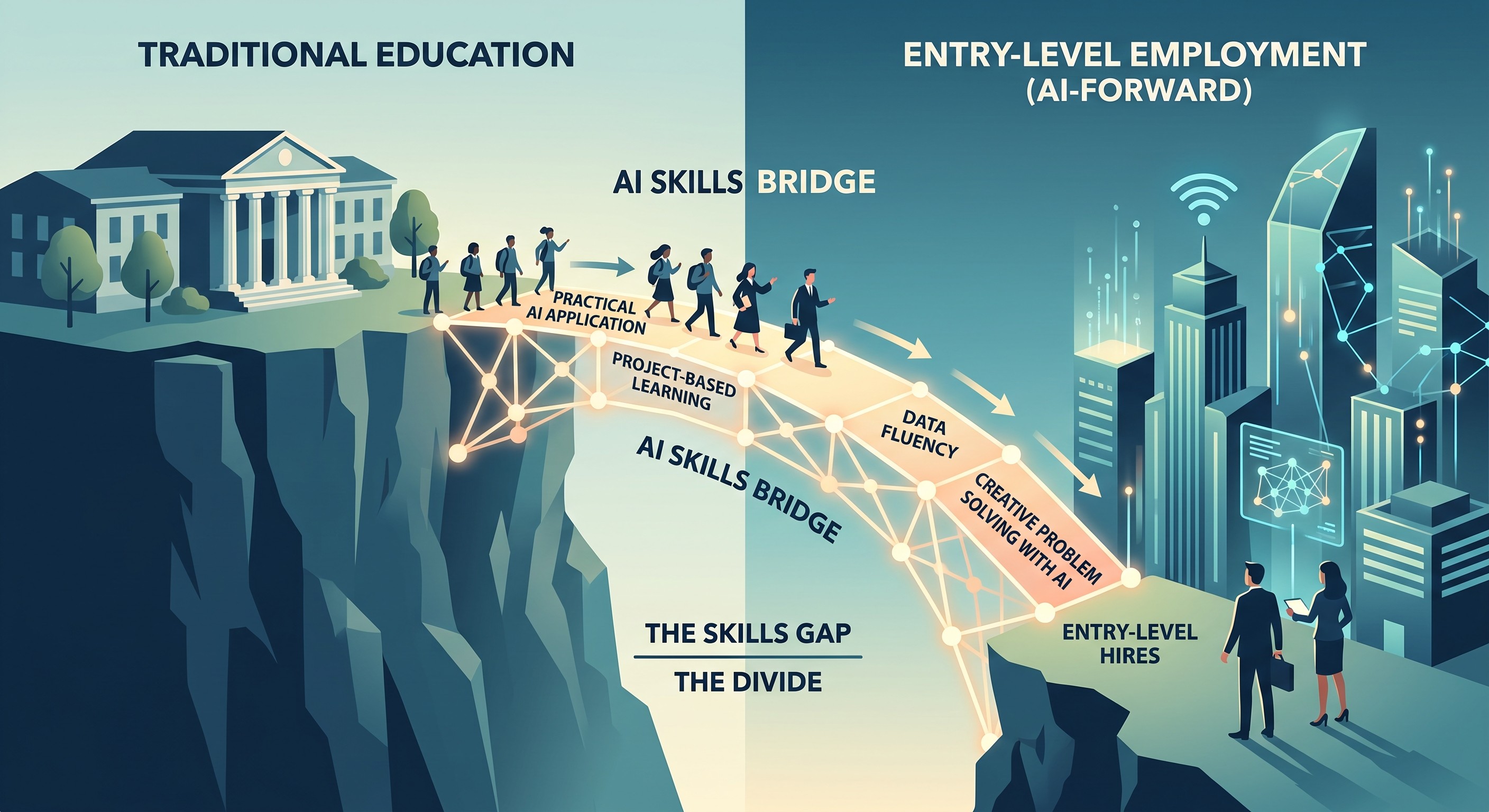
This week's edition converges on a single, urgent insight: AI is not replacing the workforce wholesale — it is selectively narrowing the entry point for young workers whose education loaded them with codified, textbook-ready knowledge but not the applied, tacit judgment that employers now prize. The Stanford Digital Economy Lab has now quantified that gap at 19% and growing. The international evidence from South Korea and Germany confirms this is structural, not cyclical. And the Coursera survey shows that even as nearly every educator personally uses AI, only about one in four universities has embedded AI literacy into the curriculum students actually receive. The good news — and this is where Jobspeaker's work with educators and employers matters most — is that Stanford's own data shows the gap narrows in occupations with higher concentrations of college graduates, and that apprenticeship-style, learn-while-you-earn models are proving their power both in teaching and in tech. The education-to-work bridge needs to be rebuilt around demonstrated, applied skills: modular credentials that carry a wage premium, employer partnerships that give learners real-world exposure before they graduate, and feedback loops fast enough to keep curricula current. Florida's PreK-to-PhD AI policy push and UPCEA's benchmarking data both point to institutions recognizing this moment as decisive. Together with our education and employer partners, Jobspeaker is committed to making sure that the learners who need it most — early-career, first-generation, and non-traditional — are the ones who benefit most from this transformation, not the ones left behind by it.
Previous article
Next article